September 9, 2026
SEO Automation and the AI SEO Agent: What Actually Runs Without You
SEO automation isn't one tool - it's a daily loop of monitoring, drafting, and flagging. Here's exactly what an AI SEO agent can run unattended, and where a human still has to decide.
What "SEO Automation" Actually Means Day to Day
SEO automation, in practice, is software that continuously watches your rankings, traffic, and site health, drafts the fixes and content it finds, and hands you a short list of decisions instead of a long list of chores. An AI SEO agent doesn't replace your judgment on what to publish or how to position your business — it replaces the manual labor of checking, noticing, and drafting. The honest version of this technology runs the monitoring and the first draft; you still approve anything that touches your public claims, pricing, or site structure.
Key Takeaways
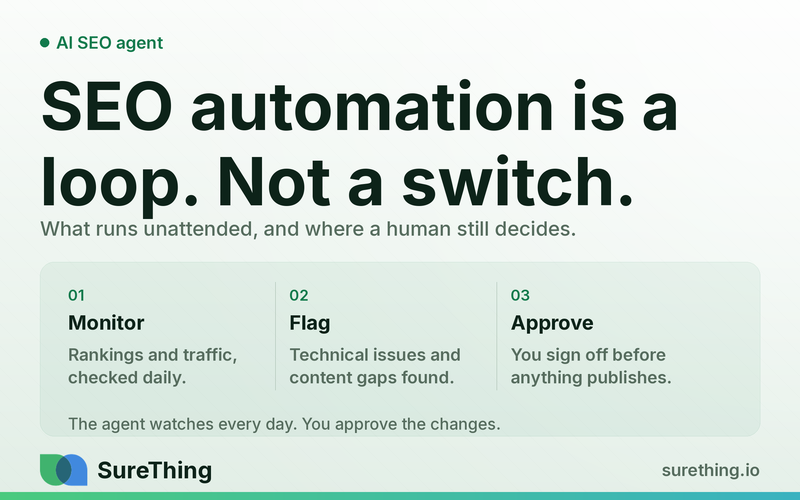
An SEO agent's core job is three things: watch (rankings, traffic, technical health), flag (issues and content gaps), and draft (fixes, outlines, pages) — not publish autonomously.
Rank and traffic monitoring can run fully unattended once it's set up correctly; it's the highest-value, lowest-risk piece of automation.
Technical issue detection (broken links, indexing errors, slow pages) is where automation catches problems weeks before an owner would notice a traffic dip.
Content gap flagging and draft generation save the most time but need a human "nod" before anything goes live, especially for claims or pricing.
Site structure changes, new page hierarchies, and anything resembling legal or regulatory language should never be fully automated.
The real bottleneck for most small business owners isn't lack of SEO knowledge — it's the absence of a standing habit to check any of this regularly.
The Real Bottleneck: Nobody's Watching Between the Quarterly Check-Ins
Most small business owners don't fail at SEO because they don't understand it. They fail because nobody on the team has 20 minutes a day, every day, to check rankings, scan for broken pages, or notice that a competitor just published a page targeting a keyword that used to be theirs. SEO work is not hard to understand at a conceptual level — "write good content, fix technical issues, build authority" — but it is hard to sustain as a habit when you're also running payroll, answering customer emails, and managing the actual business.
The result is a familiar pattern: someone does an SEO audit once, fixes a batch of issues, feels good for two months, and then drifts back to zero monitoring until traffic drops enough to notice. By the time a human notices a ranking slide or a broken page, the damage has often compounded for weeks. This is the specific gap that SEO automation is built to close — not by knowing more about SEO than a consultant would, but by never stopping to check. An agent that runs a monitoring routine in the background is solving a consistency problem, not a knowledge problem.
The second bottleneck is drafting time. Even owners who know exactly what page they need to write, or what meta description needs fixing, often sit on that knowledge for weeks because writing takes uninterrupted focus they don't have. This is where "does" — not just "watches" — becomes valuable: an agent that produces a workable first draft removes the blank-page problem, even if a human still needs to edit and approve it.
The Full Runnable Workflow: Trigger → Read → Does → Nod → Routine
Below is what a realistic, honest SEO automation loop looks like when it's running well. This isn't a hypothetical — it's the shape of the workflow that a properly configured AI SEO agent follows, broken into the five stages that matter: what starts it, what it reads, what it does on its own, where a human has to sign off, and how it becomes a routine instead of a one-time project.
Trigger
Most SEO automation loops are triggered one of three ways: on a schedule (daily rank checks, weekly technical crawls), on an event (a page's traffic drops below a threshold, a competitor publishes new content targeting your keywords, Google Search Console reports a new indexing error), or on a request (you ask the agent to find content gaps for a specific service page or location). The best setups combine all three — a standing schedule that catches slow decay, plus event triggers that catch sudden problems, plus on-demand requests for strategic work like planning a new page.
Read
Once triggered, the agent pulls and reads data from a handful of sources: rank tracking data for your target keywords, Google Search Console and Google Analytics (or your ads platform) for traffic and click patterns, a site crawl for technical health (broken links, missing meta tags, slow-loading pages, duplicate content, indexing status), and — for content gap analysis — a comparison of what your competitors' top-ranking pages cover versus what your site currently covers. This is largely the same data an SEO consultant would look at manually; the agent just looks at it every day instead of once a quarter.
Does
This is where the agent produces work product without waiting on you. Concretely, it can: draft a technical issue report with prioritized fixes (this broken link is costing you rankings, this one isn't), draft an outline or full first draft of a new page based on a content gap it identified, draft updated meta titles and descriptions for underperforming pages, draft social posts or outreach around a new piece of content, and compile a weekly or monthly summary of ranking movement and traffic trends in plain language instead of a spreadsheet. None of this requires a human to babysit the process — it's the equivalent of a research assistant doing the first pass on everything and leaving you a stack of drafts. Research on how automation changes marketing workload for small teams generally supports the idea that the time savings show up most in this drafting and monitoring stage, not in strategic decisions.
Nod
Here's the boundary that matters most: the agent drafts, a human approves. Publishing a new page, changing pricing language, making a claim about results or guarantees, restructuring your site's navigation or URL hierarchy, or merging/deleting pages all require a person to say yes. This isn't a limitation of the technology so much as a deliberate design choice — anything that's publicly visible, legally exposed, or structurally risky needs a set of human eyes that understands the business context an agent doesn't have. A good agent makes the "nod" step fast (a short summary, a clear draft, a one-click approve or edit) rather than making you dig through raw data to figure out what changed.
Routine
The workflow only earns its keep once it becomes a habit rather than a project. In practice that means: a daily automated check on rankings and technical health that only surfaces something to you when there's an actual issue, a weekly digest of content gaps and draft opportunities you can skim in ten minutes, and a monthly review where you look at trend lines and decide on bigger moves — a new service page, a site restructure, a push into a new location. This is the same rhythm covered in more tactical detail in a daily checklist built specifically for local SEO routines, though the category-level version here applies whether you're a single-location shop or a multi-service business without a strong local component.
Manual SEO vs. SEO Automation: A Practical Comparison
Task | Manual Approach | Automated (Agent-Assisted) Approach | Who Still Decides |
|---|---|---|---|
Rank and traffic monitoring | Owner or consultant logs into tools weekly or monthly, if at all | Agent checks daily, flags only meaningful movement | No decision needed unless flagged |
Technical issue detection | Discovered when traffic visibly drops or a customer complains | Crawled regularly; broken links and errors caught within days | Human confirms and approves the fix |
Content gap identification | Occasional competitor research, usually reactive | Ongoing comparison against competitor pages and search demand | Human prioritizes which gaps to fill |
New page drafting | Owner or freelance writer starts from a blank page | Agent produces a first draft based on gap analysis and existing site voice | Human edits, verifies claims, and publishes |
Site structure changes | Rarely revisited; done once at launch | Agent can flag structural issues, but doesn't restructure on its own | Human always decides and executes |
Where the Human Boundary Actually Sits
The most useful way to think about SEO automation isn't "AI vs. human" — it's a spectrum of what's safe to run unattended, what needs a quick human check, and what should never be automated at all.
Can Run Unattended
Rank tracking, traffic monitoring, uptime and crawl checks, backlink monitoring, and routine reporting can all run without a human touching them day to day. These are read-only or low-stakes activities — nothing goes public, nothing changes on your site, and the worst-case outcome of an error is a slightly wrong number in a report that a human will eventually notice. This category also includes drafting: an agent can draft a blog outline, a meta description, or a content gap report entirely on its own, because a draft that never gets approved has zero business impact.
Needs a Human Nod
Publishing anything new or updated on the live site, changing pricing pages, editing service descriptions, approving outreach emails before they're sent, and rolling out fixes that touch multiple pages at once (like a site-wide meta tag update) all need a person to review before they go live. This is also true for review responses and customer-facing communication that an agent might draft — a business owner should read it before it goes out, the same way a broader look at what AI agents can and can't do on their own points out for other operational tasks beyond SEO. The pattern holds across almost every AI agent use case in small business: draft fast, approve deliberately.
Should Never Be Fully Automated
Anything involving legal disclaimers, licensing claims, guarantees about results, health or safety statements, or regulated language specific to your industry should go through a human — and often a professional in that specific field — before it's published, regardless of how good the draft looks. This isn't an SEO-specific rule; it's a general principle for any business that operates under regulatory scrutiny. An SEO agent can flag that a page is missing a required disclosure or notice inconsistent claims across pages, but it should not be the final word on whether a claim is compliant. Site architecture decisions that affect how customers navigate or how the business is legally structured on the site (like separate location pages for different licensed entities) also belong firmly in human hands.
Frequently Asked Questions
Does an AI SEO agent replace an SEO consultant or agency?
Not entirely. It replaces the repetitive monitoring and first-draft work that used to eat most of a consultant's billable hours, but strategic decisions — which markets to target, how to position against competitors, when to restructure a site — still benefit from a human who understands your specific business. Many small businesses use automation to handle the daily grind and bring in outside expertise for quarterly strategy.
How much of my SEO can realistically run without me checking in?
Monitoring and reporting can run almost entirely without your involvement — you'll only be pulled in when something is flagged. Content drafting can also run unattended in the sense that drafts get produced automatically, but nothing should publish without your review. A realistic target is checking in for five to fifteen minutes a day on flagged items, plus a longer weekly or monthly review.
What happens if the agent flags something wrong?
Good automation is designed to over-flag rather than under-flag, and to make review fast — a short summary rather than a raw data dump. If something is flagged incorrectly, you dismiss it and move on; the cost of a false flag is a minute of your attention, not a mistake going live, because nothing publishes without approval.
Is SEO automation only useful for large sites with hundreds of pages?
No — smaller sites benefit disproportionately because the owner usually has no dedicated SEO staff at all. A five-page local business site with consistent monitoring often outperforms a fifty-page site that hasn't been checked in a year, simply because issues get caught and fixed instead of compounding.
Can an SEO agent actually write content that ranks?
It can produce a solid, structured first draft based on what's currently ranking and what gaps exist on your site, which is genuinely useful groundwork. Whether that draft ranks well depends on the same factors it always has — accuracy, usefulness, and how much human editing sharpens it before it goes live. General industry data on how search engines evaluate content quality over time supports treating AI drafts as a starting point rather than a finished product.
Where to Go From Here
If any of this sounds like the gap in your own routine — knowing roughly what needs to happen for your SEO but never having the consistent time to do it — that's the specific problem this category of automation is built to solve. You don't need to overhaul your whole marketing setup to benefit from it; even just automating the monitoring and drafting stages while keeping every publish decision in your hands is a meaningful shift from where most small businesses currently sit. If you're comparing options, a broader look at AI agents for small business in the year ahead is a reasonable next read alongside this one. And if you want to see what a monitoring-and-drafting loop like this looks like in practice rather than in theory, it's worth exploring at your own pace, on your own timeline, with no pressure to change everything at once.