August 26, 2026
Local SEO Automation: The Daily Checklist to Automate, and the Four Calls to Keep Human (2026)
Local SEO rarely breaks because of the wrong keywords. It breaks because the small daily check never gets run — and a wrong opening-hours field can sit live for six weeks. Here is the nine-item daily checklist, the four loops worth automating, and the four decisions to keep human.
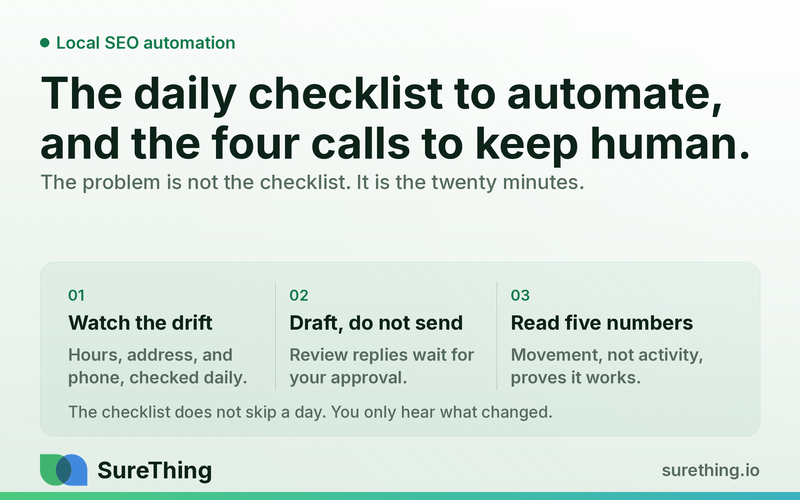
Short answer: local SEO rarely falls apart because you chose the wrong keywords. It falls apart because the small daily check — did the listing change, did a review come in, did a page break, did we slip on the terms that actually bring calls — never gets run. Nobody schedules twenty minutes for it, so it happens in bursts, usually right after something has already gone wrong. That is the part to automate: the watching, the checking, and the first draft of every reply. The judgment stays with you.
Below is the checklist itself, the four loops actually worth handing to an agent, how to stand it up in one morning, and the five numbers that tell you within three weeks whether it is working. This is not a tool roundup — most of what gets sold as local SEO automation is reporting, and reporting is the cheap half. If you want the wider picture of what an agent does across a small business day, that is covered separately.
Key Takeaways
Automate the watching, not the deciding. Google's own guidance says local results come mainly down to relevance, distance and prominence (Google Business Profile Help). Distance you cannot move, relevance is a positioning decision, and prominence is fed by things that quietly rot day to day: reviews, accurate listing details, pages that still load.
The daily check is nine small items, and six of them are pure monitoring. Those six are what a machine should own. The other three need a human who knows the business.
Review replies and listing edits should arrive as drafts, not as posts. Reply speed is worth real money; unsupervised publishing under your business name is not.
A short Monday digest beats a live dashboard. A digest that only shows what changed gets read. A dashboard gets bookmarked and forgotten.
Judge it on five numbers, starting with days-to-detect. If nothing on that list moves in three weeks, the loop is watching the wrong things.
The problem is not the checklist. It is the twenty minutes.
Every owner running a location-based business already knows roughly what to check. Ask and you will get most of the list back. The checklist is not the missing piece. What is missing is a recurring twenty minutes that belongs to someone, on a day when nothing is on fire.
Here is the shape of it — a composite, not a customer story. A bakery with two locations edits its Sunday hours before a holiday weekend and never changes them back. For six weeks the listing tells everyone searching that Sunday is closed. Sunday is their second-busiest day. Nobody on staff is wrong, nobody was careless — the field was simply edited once, correctly, for one weekend, and no process existed to put it back. It surfaces when a regular mentions it at the counter.
Six weeks of a wrong field is not a strategy failure. It is drift. Drift is what daily automation is actually for, and it is why “we do local SEO quarterly” quietly costs more than it looks.
Want the daily check to simply happen? Set up a morning routine in SureThing — it watches your listing details, your key pages and your new reviews, and messages you only when something has actually moved.
What actually belongs on a daily local SEO check
Nine items. The column that matters is the last one.
What to check | What silently breaks | How often | Who owns it |
|---|---|---|---|
Opening and holiday hours | A one-off edit never gets reverted | Daily | Machine |
Name, address, phone vs. your own site | New number updated in one place only | Weekly | Machine |
New reviews | A two-star sits unanswered for a week | Daily | Machine drafts, you approve |
Questions on your listing | A stranger's wrong answer becomes the default answer | Daily | Machine flags, you answer |
Booking page and location pages load | A 404 after a site edit | Daily | Machine |
Search positions for your local terms | A slide from #4 to #9 nobody notices | Weekly digest | Machine |
Photos and post cadence | Nothing new added in two months | Weekly nudge | You or your staff |
Duplicate or stale listings | A duplicate appears and splits your reviews | Monthly | Machine flags, you resolve |
Who is newly outranking you | A new entrant takes the third slot | Monthly | Machine flags, you decide |
Six of the nine are pure watching: hours, contact consistency, page availability, positions, duplicates, competitor set. None of them need taste. They need someone to look every single day, which is precisely what people are bad at and software is good at. The industry specifics change the wording of the list, not its shape — the same nine run for a dental practice and for a field service company.
The four loops worth handing over
Loop 1 — the morning drift watch
Runs once, early, before you open. It compares your listing details against a ground-truth file you wrote once — hours, phone, address, categories — and checks that your booking page and location pages still return a page instead of an error. If everything matches, it says nothing. That silence is the feature. If something moved, you get one short message naming the field, the old value and the new value, and you decide whether it was a real change or an accident.
Note what it does not do: it does not silently rewrite your business identity. Detection is safe to automate; editing the public record of what your business is takes a yes.
Loop 2 — review replies as drafts
Twice a day, new reviews come in and a reply comes back written in your voice, shaped by the rating. Five stars gets short and warm, and names the specific thing the customer mentioned. Three stars and below acknowledges the experience, does not argue the facts in public, and offers a real route off the public thread — a name and a direct line. Every one lands as a draft waiting for your approval. Nothing posts without it.
Two rules keep this out of trouble. Never dispute a factual claim in a public reply, and never put anything specific about a person's treatment, case, or order dispute into a public reply. “Let's sort this out directly” is almost always the right public answer.
Loop 3 — the Monday movement digest
Once a week it pulls your Search Console numbers for the local terms you care about, compares the last seven days against the seven before, skips the most recent two or three days because that data lags, and returns only movement. Terms that gained or lost position. Pages picking up impressions but getting few clicks. Each line comes with one recommended action, not a chart.
This is the loop that separates automation from dashboards. We run this exact weekly comparison on our own blog, and the rule that makes it useful is boring: only show what changed. A digest of eight lines gets read on a Monday. Forty rows do not.
Loop 4 — the fix queue
Findings are useless in a pile. The fourth loop turns the week's findings into a short ordered list of what is worth fixing now, and then drafts the actual change for the top item — for example, a rewritten page title and description for a page sitting between positions five and fifteen with a weak click rate. You approve the wording, and it goes in. This is the same pattern as a marketing assistant that drafts and waits: the work arrives finished enough to judge in thirty seconds.
These four are routines, not a project. Start with the drift watch — it is the one that pays back first, and the one you will never build a habit for by hand.
How to stand it up in one morning
Write the ground truth once. Hours per location, phone, address, categories, the five pages that must never break, and the ten local terms you actually care about. Everything else depends on this file being right, so spend real time here and nowhere else.
Connect Search Console, read-only. This is what turns the weekly digest into numbers instead of impressions of numbers.
Turn on the morning drift check as a daily routine. Give it one instruction: message me only when something moved.
Turn on review reply drafts, with your approval as the gate. Write two or three sentences about how you speak to customers; that is the whole voice configuration.
Schedule the Monday digest. Same rule as step three: only what changed.
Then stop. Do not add anything else in week one. One week of quiet mornings is the test of whether your ground-truth file is actually right — and if it is wrong, you want to find that out on five checks, not fifty.
That is the whole setup. Build your morning local SEO check in SureThing — it takes about as long as one coffee, and the ground-truth file is the only homework.
The four calls to keep human
Whether a bad review is a pattern or an outlier. A machine can count that three people mentioned the wait. Only you know that you are one person short on Saturdays and that this is a staffing decision wearing a review's clothing.
What your business actually is. Categories, service descriptions, positioning — this is the relevance half of Google's three factors, and getting it “optimized” by something that has never worked your counter is how you end up ranking well for work you do not want.
Anything published under your business name. Hours, address, replies, posts. Drafting: automate. Publishing: approve.
When to stop chasing a term. A term that brings clicks and no bookings is a term to drop. No amount of position data makes that call for you.
The five numbers that tell you it is working
Days to detect. In the bakery example above it was six weeks. Under twenty-four hours is the whole point of loop one, and it is the fastest number to move.
Median time to first review reply. Same day is a realistic target once drafts are waiting for you instead of waiting to be written.
Count of your local terms sitting in the top three. A count, not an average position — averages hide the only thing that matters, which is whether you are in the visible set.
Click rate on your five main local pages. This is the number that tells you the fix queue is doing its job, because titles and descriptions are what it mostly fixes.
Bookings or orders that came in through local search. The one that actually matters. If you do not have analytics wired up for this, count the ones who say they found you on Google or Maps — imperfect, directional, still better than guessing.
Three weeks is enough to read all five. If days-to-detect drops and nothing else moves, the loops are running but pointed at the wrong terms — fix the ground-truth file before adding anything.
FAQ
Is local SEO automation just another tool subscription?
Most of what is sold under that name is reporting — it tells you your rank and your review count. Useful, and the cheap half. The half that pays is the daily loop with an approval gate: something notices, something drafts, you say yes. If a product cannot show you that loop, it is a dashboard.
Will Google penalize automated review replies?
Penalties are not the real risk here. The real risk is a wrong or tone-deaf reply sitting in public under your business name, which no algorithm needs to punish — customers do it directly. That is the entire argument for drafts over autopublishing.
How is this different from a rank tracker?
A tracker tells you where you stand. These loops tell you what changed since yesterday, and hand you the draft of the fix. The difference shows up on the day you are too busy to look — the tracker still tracks and nobody reads it; the loop puts one sentence in front of you.
Can it run for more than one location?
Yes, and it should — drift is more common with more locations, because more people have edit access. One ground-truth entry per location, and keep the digest per location too. A merged digest across five locations is the fastest way to make a useful report unreadable.
How much of my week does this give back?
Honestly: it does not remove the work, it removes the question “did anyone check?” Setup is one morning. After that it is a few minutes a day approving drafts, and one Monday read of eight lines. The saving is not hours on a timesheet — it is the six weeks of wrong hours that no longer happens.
Next step
Pick loop one and nothing else. Write your ground-truth file, put a check on it every morning, and let it stay silent for a week. When the first message does arrive naming a field that moved, you will already know what this is worth. Set it up in SureThing — the agent watches, drafts, and waits for your yes; it does not publish on your behalf.