August 27, 2026
Google Ads for Dentists: The Budget Leaks at the Phone, Not the Keyword (2026)
Most dental Google Ads budget is not lost in the auction. It is lost in the ninety seconds after the click — the call that rang out, the form that waited until Monday. Four leaks, and what a practice must never automate.
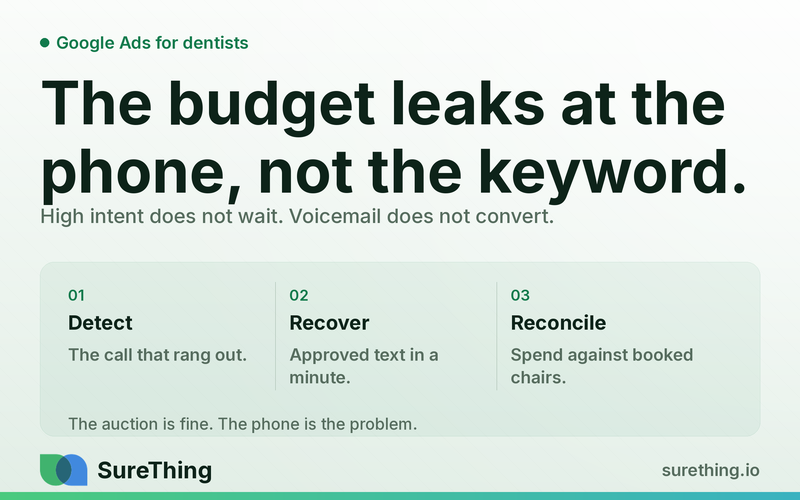
Key takeaways
Most dental Google Ads budget is not lost in the auction. It is lost in the ninety seconds after someone clicks — the call that rang out, the form that sat until Monday.
A dental click is expensive because it is a high-intent local purchase. Paying that much for a lead and then answering it slowly is the most expensive habit in the category.
Four leaks account for almost all of it: the unanswered call, the after-hours form, keywords that book the wrong appointment, and spend that is never reconciled against booked chairs.
Automate the watching, the routing, and the drafting. Keep every clinical word, every price quote, and every treatment question with the practice — Google's own healthcare policy and basic sense both require it.
Judge the account on booked chairs and answer speed, not on clicks or cost-per-lead. Cost-per-lead improves when you ignore the phone; booked chairs do not.
The money leaks after the click, not before it
Ask most practices how their Google Ads are doing and you get an account answer: impressions, clicks, cost-per-click, maybe cost-per-lead. All real numbers, all measuring the half of the funnel that Google already handles competently.
The half nobody measures starts the instant someone taps the ad. A person with toothache searches, clicks, taps the call button, and gets four rings and voicemail because the front desk is with a patient. That call cost the practice a click at local-dental rates and produced nothing — and worse, it produced nothing invisibly. It does not appear in the ads dashboard as a failure. It appears as a click you paid for and a lead you never knew existed.
This is the specific reason dental advertising has a reputation for burning money. Not bad targeting. Not bad copy. The auction is competitive but functional; the response is where practices lose. A dental patient in pain is not comparison-shopping over a week — they are calling until someone picks up. Second place in that race is worth zero.
So this article is not another guide to structuring campaigns. It is about the operational layer underneath: what should be watching your ad-driven enquiries continuously, what it should be allowed to do on its own, and what has to stay with a human in a dental practice.
What a dental practice is actually buying with Google Ads
Worth being precise, because it changes what you optimise. You are not buying traffic. You are buying a small number of high-intent local moments, each of which is either converted within minutes or lost.
Those moments come in roughly three shapes, and they behave completely differently:
Urgent. Pain, a broken tooth, a lost crown, a child's accident. Searched on a phone, converted by a phone call, decided in minutes. Highest intent in the category and the least tolerant of delay.
Considered. Implants, orthodontics, cosmetic work. Researched over days or weeks across several practices, converted by a consultation booking, and heavily influenced by whether anyone followed up.
Routine. A cleaning, a check-up, a new patient in the area. Moderate intent, price-and-convenience sensitive, often converted by whichever practice made booking easiest.
One campaign treating all three identically is the most common structural mistake, but it is a campaign problem with well-documented fixes. The operational problem is that all three arrive through the same front desk, which is already busy with the patient physically in the chair.
Leak one: the call that rang out
This is the biggest leak and the least discussed, because fixing it looks like an operations problem rather than a marketing one.
Most ad-driven dental enquiries are calls, not form fills — which is why Google's call assets exist and why so much of the mobile ad real estate is a tap-to-call button. That means your conversion rate is largely a function of whether the phone gets answered, and the phone is being answered by someone whose primary job is the patient in front of them.
The automatable part is not answering the phone. A machine should not be the voice of a dental practice. The automatable part is the recovery:
A missed call is a trigger. Within a minute of a call from an ad-driven number going unanswered, a text goes out — an apology, the practice name, and one question: is this urgent, and would you like us to call you back or would you rather book online? Simultaneously, the missed call lands in a queue the front desk can clear at the next gap, with the caller's number, the time, and the campaign it came from.
Two things about that text. It is a template the practice wrote and approved once, not something generated fresh per caller — this is the one place where a fixed, boring message beats a clever one. And it never diagnoses anything. It acknowledges and routes. Everything clinical waits for a person.
Leak two: the form that waited until Monday
The considered-treatment enquiries arrive as forms, and they arrive disproportionately in the evening — people research implants after work, not at eleven in the morning.
The manual version fails predictably. A Friday-evening implant enquiry sits in an inbox until Monday. By Monday, that person has enquired at three practices and had a conversation with whichever one replied Saturday morning. The enquiry was not lost to a competitor's marketing; it was lost to a competitor's response time.
The running loop: form arrives, gets acknowledged immediately with a real message that says when a human will call and offers a booking link for a consultation. Then it gets classified — urgent, considered, or routine — and lands in the right queue with the right follow-up cadence. For considered treatments the cadence matters more than the speed, because these decisions genuinely take weeks; a single unanswered enquiry that gets two thoughtful follow-ups over ten days converts far better than one that got an instant autoresponder and then silence.
The draft of each follow-up is written for the front desk to approve, not sent blind. We covered the mechanics of this queue in more detail in dental marketing automation and new-patient follow-up — that piece is about the follow-up itself, where this one is about the paid traffic feeding it.
Leak three: keywords that book the wrong appointment
Here the ads account and the schedule disagree, and the account usually wins for months before anyone notices.
Broad dental terms convert. They just convert into appointments that do not pay for the click — the price shopper who books a cleaning and cancels, the enquiry for a treatment the practice does not offer, the person forty minutes outside the catchment. Cost-per-lead looks fine. Revenue per lead is quietly terrible.
Google's Quality Score documentation explains the auction side of relevance well, but it can only measure relevance to the search — not relevance to your chair. That second judgment needs data the ads account does not have: which enquiries became booked appointments, which became completed treatments, and which wasted twenty minutes of front-desk time.
What an automated loop contributes is the boring reconciliation nobody does weekly: match enquiries against booked and completed appointments, group by campaign and search term, and surface the terms producing enquiries that never become chairs. Then a human decides what to cut. That decision involves knowing that implant enquiries take six weeks to convert and cleanings take three days — context a spend report does not contain.
The same weekly discipline applies to the organic side of a practice's visibility, which we wrote up as a daily checklist in local SEO automation. Paid and organic share one front desk, and both die at the same bottleneck.
Leak four: nobody reconciles spend against booked chairs
Most practices review ads monthly, in a meeting, using the platform's own numbers. That is too slow and the wrong source.
The number that matters is not in Google Ads. It is the join between spend and the practice management system: money out this week, enquiries in, appointments booked, appointments attended. Nobody produces that join manually more than a few times, because it means exporting two systems and reconciling them by hand.
Automated, it is a five-line Monday digest: spend, enquiries, booked, attended, and the one search term that changed most. No charts. If a number needs a chart it needs a conversation. This is the same reporting loop we described as the fourth back-office loop in back office automation, pointed at the ads account instead of the invoices.
What the machine runs, and what stays with the practice
The left column is safe to automate fully. The right column stays human in a dental practice even when a machine could technically produce the words.
Leak | Machine owns | Practice decides |
|---|---|---|
Missed calls | Detecting the miss, sending the approved acknowledgement text, queueing the callback with campaign context | Every call back, and anything about symptoms, urgency, or treatment |
Forms | Instant acknowledgement, classifying urgent vs considered vs routine, drafting the follow-up sequence | Sending anything that discusses treatment, suitability, or price |
Keywords | Reconciling enquiries to booked and attended appointments, flagging terms that never become chairs | What to pause, what to bid up, and which treatments to advertise at all |
Reporting | Joining spend to the schedule, writing the weekly five-line digest | What the numbers mean and what changes next week |
All four | Running at 8pm on a Saturday, when a third of high-intent dental searches happen | Anything a patient would read as clinical advice from the practice |
The line is the same one that governs every loop we build: automate the watching, the routing, and the drafting; keep the clinical judgment and the sending. In dentistry that line is not a preference, it is a requirement — see the boundaries section below.
A worked example, end to end
The figures below are an illustrative worked example, not a client case. The arithmetic is the point; substitute your own numbers, because dental click costs vary enormously by city and treatment.
Take a two-chair general practice running a modest monthly search budget across three campaigns: emergency, implants, and new-patient cleanings. Say that budget buys a few hundred clicks a month, and roughly one in six of those clicks produces a call or a form.
Before. Calls are answered when the desk is free, which during treatment hours is perhaps two-thirds of the time. Missed calls are visible in the phone log, which nobody reviews. Evening and weekend forms are read the next working morning. Keyword decisions are made monthly from the ads dashboard alone. Nobody knows which campaign produced last month's implant consultation.
After the recovery loop only — missed-call text plus a callback queue, two weeks: the number that moves is not cost-per-lead, it is the share of ad-driven callers who reach a human at all. Callers who would have vanished into voicemail now get an acknowledgement inside a minute and sit in a visible queue. Some book online without a callback, which is the cheapest possible outcome.
After the form loop — instant acknowledgement plus an approved two-touch follow-up over ten days: considered treatments start converting on the practice's schedule rather than on whoever replied first. This is the slowest loop to show results, because the sales cycle genuinely is weeks long. Do not judge it in a fortnight.
After reconciliation: the first Monday digest is usually the uncomfortable one, because it is the first time spend sits next to attended appointments in the same table. That is also where the biggest single saving normally appears — one broad campaign quietly producing enquiries that never became chairs.
Four numbers to write down before you start, because you will not remember them later:
Share of ad-driven calls answered by a human. Moves within days.
Time to first response on an out-of-hours form. Moves immediately.
Enquiries that became attended appointments, by campaign. Moves in weeks.
Spend per attended appointment. The only cost number worth reporting to an owner.
Where this breaks
Four honest limits, and the first two are hard rules rather than advice.
Clinical judgment is off limits, always. No automated message may assess symptoms, suggest urgency, recommend a treatment, or reassure a patient about a condition. Acknowledge, route, and book — nothing else. Our own scope stays in marketing, scheduling, communications, and admin, and we hold that boundary deliberately in every clinical vertical we work in.
Advertising policy constrains the copy. Healthcare advertising sits under specific rules, and Google's healthcare and medicines policy is the document that governs what a dental practice may claim in an ad and what certifications apply. Automation does not change what you are allowed to say. A practice's ad copy and its listing details — governed separately by Google's guidelines for representing your business — remain a human sign-off, every time.
Fixing response before fixing capacity makes things worse. If the schedule is genuinely full, a faster funnel produces more people you cannot see, and disappointing a patient who reached you in ninety seconds is worse than never having answered. Capacity first.
Attribution stays imperfect. Joining spend to attended appointments is a large improvement over the ads dashboard alone, and it is still an estimate — walk-ins mention the ad they saw last week, referrals get credited to search, and phone attribution is imperfect. Use it to make decisions, not to prove a number to two decimal places.
FAQ
Is this a replacement for a dental marketing agency?
No, and the two solve different problems. An agency builds and tunes the account. This is the operational layer that catches what the account delivers — the recovery, the routing, the reconciliation. A well-run account feeding an unanswered phone still loses money.
Should the practice use an AI receptionist to answer calls?
Our position is no for a dental practice, at least on the first call. People calling about pain want a person, and the failure mode of a machine mishandling a clinical question is far more expensive than a missed call. Automate the recovery, not the conversation.
What if the practice has no online booking?
Then the missed-call text offers a callback instead of a link, and the loop still works — it just converts more slowly. Online booking is the single biggest multiplier on any of this, because it is the only path that converts without consuming front-desk time.
How does this differ from what already runs on the organic side?
The loops are close cousins. Paid traffic is more urgent and more expensive per enquiry, so the response window is tighter; organic visibility is a slower, compounding job. If you are choosing where to start, the general principle we use is in how to pick the one thing to automate first: start with the loop that is already annoying you.
Next step
Before changing a single bid, measure one thing for a week: how many calls from your ad number went unanswered, and how long out-of-hours form enquiries waited. Most practices have never counted either, and the count usually settles the question of where to start.
Then close the recovery loop first — missed call detected, approved text out inside a minute, callback queued with the campaign attached. In SureThing that runs as an agent watching the enquiry stream continuously and leaving the human contact for the practice to make. It does not talk to patients about treatment, and it does not send anything clinical under your name.