August 29, 2026
AI Agent vs Chatbot: One Answers, The Other Finishes the Job (2026)
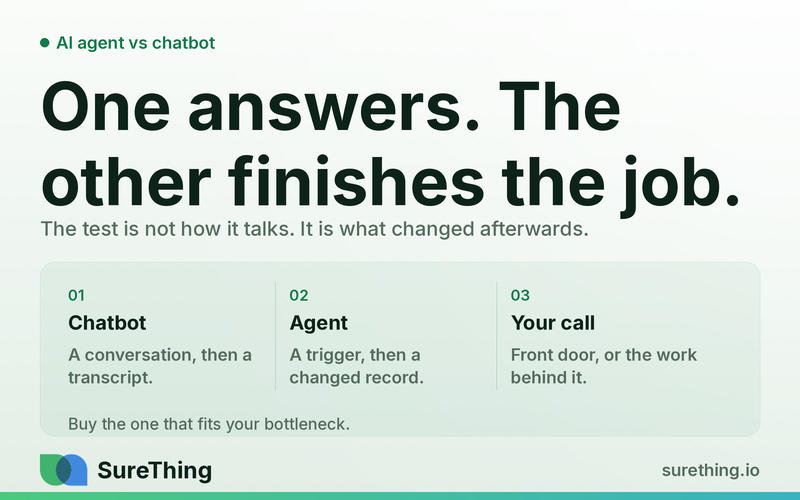
A chatbot answers and leaves a transcript. An agent acts and leaves a changed record. The test that tells them apart in one question, a side-by-side table, and how to work out which one your business is actually short of.
Key takeaways
A chatbot answers. An agent acts. That is the whole difference, and every other distinction follows from it.
The useful test is not how the thing talks — it is what changes when nobody is watching. If your calendar, inbox, or CRM is different afterwards, it was an agent.
Chatbots are measured in conversations handled. Agents are measured in work completed. Pick your metric before you buy, because the two lead to opposite purchases.
Most small businesses asking for a chatbot want deflection at the front door. Most who need an agent are drowning in follow-up nobody has time to do.
The safety line is the same for both, and it is about the send button, not the intelligence: drafting and routing can run unattended, irreversible outbound actions get a human yes.
The short answer
A chatbot is a conversation. Somebody asks something, it replies, and when the tab closes nothing in your business has changed. A good one changes what the customer knows.
An agent is a worker. It is given a job, it watches for the conditions that mean the job needs doing, it uses your actual tools to do it, and when it finishes something in your business is measurably different — a lead has been chased, an invoice has been flagged, a listing has been corrected.
Everything else people argue about — whether it uses a large language model, whether it "reasons", whether it has memory — is implementation detail. Ask one question instead: after it runs, is there a change I could point at?
That test cuts cleanly through the marketing. A support widget that answers forty questions and files zero tickets is a chatbot, however sophisticated its language. A dull script that checks your inbox every ten minutes and drafts three replies for approval is an agent, however unimpressive its prose.
Why the words got muddled
Worth a paragraph of history, because it explains why vendor pages are so confusing right now.
Chatbots are old. ELIZA was written in the mid-1960s and did nothing but pattern-match and reflect language back — no understanding, no actions, and it still convinced people it was listening. That lineage ran through decision-tree support bots for sixty years: scripted, deflection-focused, and firmly inside the conversation.
What changed is not that the language got better. It is that models were given hands. The mechanism has a boring name — function calling — and it means the model can emit a structured request to run a real operation instead of only emitting words. Pair that with the pattern of interleaving reasoning and actions in a loop, described in the ReAct paper in 2022, and you have the ingredient that makes an agent an agent: it can observe, decide, do, look at the result, and decide again.
Anthropic's engineering write-up on building effective agents draws a further line inside that category which matters more than the chatbot comparison for most buyers: between a workflow, where the steps are fixed in advance and a model fills in the judgment, and an agent, where the model decides the steps. Most small-business work that pays off is the first kind. That is not a downgrade — a predictable loop you can audit beats an improvisational one for anything touching customers or money.
The difference that shows up in your week
Definitions are cheap. Here is how the two feel different to run.
A chatbot's failure is visible and cheap. It gives a wrong answer, the customer rephrases or asks for a human, and you lose a little goodwill. You find out because someone complains.
An agent's failure is invisible and expensive. It stops running on Tuesday and nothing screams. The follow-ups quietly do not go out, and you notice three weeks later when the pipeline looks thin. This is the single most important operational difference and almost nobody mentions it in a sales deck: an agent needs monitoring, a chatbot mostly needs editing.
It also changes what you are buying. A chatbot's value is bounded by your traffic — no visitors, no value. An agent's value is bounded by how much repetitive work you have, which for most owner-run businesses is a far larger number. We made this argument at length in how AI agents take over repetitive work; this piece is the decision layer above it.
Side by side
Dimension | Chatbot | AI agent |
|---|---|---|
Triggered by | A person opening a conversation | An event, a schedule, or a condition being met |
Runs when | Someone is there to talk to it | Continuously, including at 3am |
Touches | Its own reply box, sometimes a knowledge base | Inbox, calendar, CRM, ad account, spreadsheets, your site |
Leaves behind | A transcript | A changed record, a draft awaiting approval, a log of what it did |
Fails by | Answering wrong, out loud | Stopping quietly, or acting on a stale assumption |
You measure | Conversations handled, deflection rate | Work completed, response time, tasks needing rework |
Needs from you | Good content and periodic editing | Tool access, a clear boundary on what it may send, and monitoring |
Breaks even when | You have enough inbound volume to deflect | You have recurring work nobody has time to finish |
Which one you actually need
Two questions settle it for most businesses, and neither is about technology.
Question one: where does the work pile up? If people ask you the same twelve questions and you answer them all day, your bottleneck is at the front door and a well-fed chatbot or a decent FAQ page earns its keep. If the questions are fine but the follow-up never happens — the quote you meant to chase, the enquiry from Friday, the reconciliation nobody does — your bottleneck is behind the door and no amount of conversational polish will touch it.
Question two: is your problem that people can't get answers, or that you can't get through the list? The first is a chatbot problem. The second is an agent problem. Owners routinely buy the first while suffering the second, because the first is what gets marketed.
The uncomfortable version: if your enquiries are already being answered slowly by a human, adding a chatbot makes the front door faster and the bottleneck worse. You have accelerated the intake into a queue that was already backed up.
Our general rule for sequencing this is in how to pick the one thing to automate first, and it applies here unchanged: start where the pain already is, not where the demo is most impressive.
What an agent looks like when it is running
Abstraction is where this topic goes to die, so here is a concrete loop — deliberately unglamorous, and typical of what actually pays for itself.
The trigger. A form submission arrives, or a scheduled check runs at 8am. Nobody clicked anything.
The system. The agent reads the enquiry, checks whether this person already exists in the CRM, checks the calendar for real availability, and looks at whether anyone has replied to them yet.
What the agent does on its own. Classifies the enquiry, writes it into the CRM with the source attached, drafts a reply in the business's voice referencing the correct availability, and — if this is the third silent day on an earlier enquiry — drafts the follow-up too.
Where the human comes in. The drafts sit in a queue. The owner or front desk reads them, edits anything off, and hits send. Two minutes for what used to be forty.
The routine. This repeats without being asked — every submission, every morning, including the mornings the owner is on site with a customer.
A chatbot in the same business would have answered "what are your opening hours" at 11pm. Useful, genuinely. It would not have chased anybody.
Two worked versions of exactly this loop, in real verticals: the new-patient follow-up queue in dental marketing automation, and the missed-call recovery loop in Google Ads for dentists, where the enquiry is expensive and the response window is ninety seconds.
The boundary, which is identical for both
People assume agents need tighter rules than chatbots because they are more capable. The real reason is narrower and more useful: agents can take irreversible actions, and the rule follows the reversibility, not the intelligence.
The line we hold, in every loop we build:
Runs unattended: watching, classifying, enriching, drafting, queueing, internal record-keeping, reporting. All reversible, all invisible to the customer if wrong.
Needs a human yes: anything outbound under the business's name, anything that moves money, anything that commits calendar time with a third party, anything a customer would read as a promise.
Never automated at all: regulated professional judgment. Clinical, legal, tax, insurance, and investment advice stay with the licensed human, full stop. We keep our own scope in marketing, operations, communications, and admin for exactly this reason.
If you want a formal frame for thinking about the risk side, NIST's AI Risk Management Framework is the reference most compliance conversations end up pointing at. For a five-person business the practical version is one sentence: let it draft anything, let it send nothing you would not want sent in your name by mistake.
Where this breaks
Four honest limits.
An agent inherits the quality of your tools. If the CRM is half-empty and the calendar is not the real source of truth, the agent will act confidently on bad data. Chatbots degrade gracefully here; agents do not. Fix the source of truth first.
Silent failure is the real risk, and it needs a countermeasure. Any loop worth running needs a heartbeat — something that tells you it ran and how many items it touched. A loop nobody checks is a loop that will be dead for a fortnight before you notice.
Volume is the honest test for a chatbot. Below a certain inbound volume, a good FAQ page and a fast human beat any bot, and the bot is a rounding error on your week. Do not buy conversation software to solve a workload problem.
"Fully autonomous" is usually a euphemism. When a vendor says the agent needs no supervision, ask what happens the first time it is confidently wrong in front of a customer. The good answer involves an approval step. The bad answer involves the word "rare".
FAQ
Can one thing be both?
Yes, and the best support setups are. A chat interface handles the conversation, and behind it an agent creates the ticket, updates the record, and drafts the human follow-up. The interface is not the category — the actions behind it are.
Is an AI agent just automation with better language?
Close, and the distinction that matters is who chooses the steps. Classic automation follows a path you drew in advance. An agent decides which path applies, and for customer-facing work you generally want the tighter version: fixed steps, model judgment inside them. Predictable beats clever when it is your name on the email.
Do we need to replace our chatbot to use agents?
No. They sit at different points — the bot at the front door, the agent in the work behind it. Ripping out a working bot to install an agent solves nothing; the two address different bottlenecks.
How do we know it is working?
Pick the number before you start, and make it work-shaped rather than conversation-shaped: time to first response, share of enquiries that got a follow-up at all, items needing rework. The reporting loop for this is the fourth one in back office automation, and it is the loop most businesses skip.
Next step
Before evaluating any product, write down the last five things that did not get done last week. Not the questions you were asked — the tasks that slipped. If most of them are answers you owed people, you have a front-door problem. If most are chases, checks, and reconciliations, you have an agent-shaped hole and a chatbot will not fill it.
Then take exactly one of those slipped tasks and describe it as a trigger, a set of tools, and a point where you want to say yes. That description is the whole specification. In SureThing that is what an agent is configured from, and the approval step stays yours by default — nothing goes out under your name without a human behind it.