September 7, 2026
Salon Social Media Marketing: Connecting the Feed to the Booking Calendar
Salon social media usually fails from inconsistency, not lack of content, and the DMs it generates go unanswered next to the calendar. The loop that drafts a week of posts and turns inbound questions into booked times, without fabricating results.
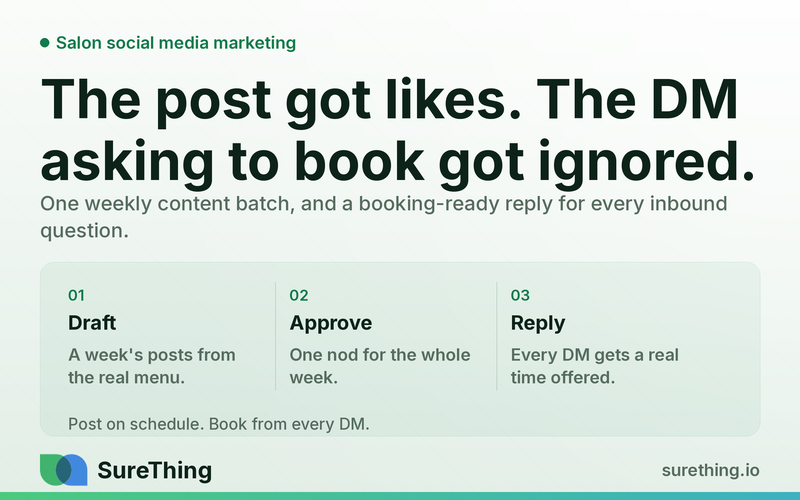
Key Takeaways
Salon social media usually fails from inconsistency, not lack of content — posting happens when someone remembers, then stops for two weeks, and inbound DMs asking about availability sit unanswered next to the posts.
The two problems are connected: content and booking live in different places, so a comment asking "do you have Saturday open?" gets a like instead of a time.
The fix is a loop that drafts a week of posts from the real service menu and season, gets approved once, and turns inbound questions into specific booking replies rather than generic "DM us" answers.
Nothing here fabricates results. No before/after transformation numbers, no invented client testimonials, no performance claims the salon cannot back with its own data.
Publishing itself, and any claim about a specific stylist's technique or a client's hair/skin condition, stays with a person — the loop drafts and schedules, it does not decide what's true about a client's hair.
The Short Answer
A salon's social feed and its booking calendar are almost always run as two separate habits — someone posts when they think of it, and someone else answers the phone or DMs when they notice. The feed goes quiet during a busy week, and the comment asking about Saturday availability sits unanswered until someone happens to check Instagram. The fix is not "post more" — it is connecting the two: a weekly batch of posts drafted from what the salon is actually doing that week, approved once by the owner, and a separate but same-system habit of turning every inbound question into a specific time offer instead of a vague reply. This article covers both halves of that loop and where automation should stop.
Why the Feed Goes Quiet
Nobody in a salon has "post to Instagram" as their job. It is the thing squeezed in between clients, and it competes for that time with everything else that also feels urgent. The result is a familiar pattern: three posts in the first week of the month, then a gap, then a burst of stories around a promotion, then quiet again. Followers notice the gap more than the burst — an inconsistent feed reads as an inconsistent business, even when the actual service quality never changed.
The deeper issue is that posting decisions get made from nothing. Without a plan, "what do we post today" defaults to whatever is easiest to photograph in the next five minutes, which tends toward the same few angles repeated — a finished color, a before/after silhouette, a product shelf. Social commerce is the use of social networks and user-generated content in the context of buying and selling, and a salon's feed is exactly that kind of surface — but it only functions as one when there is a plan behind what gets shown and when, not a scramble each morning.
The Other Half: Where the DMs Go to Die
The second, less visible problem is what happens after someone actually engages. A comment or DM asking about availability, pricing, or a specific service is a warmer lead than almost any ad click — the person is already looking at the work and decided to ask. What usually happens next is a generic reply ("Thanks! DM us to book") that hands the actual scheduling work back to the person who was interested enough to ask in the first place. Some of them will follow through. Many will not, because the moment of interest has passed by the time they open a booking page and start hunting for an open slot themselves.
User-generated content shifts the audience from passive viewers to people who create, comment, and share — a client tagging the salon in their own post, or asking a question in the comments, is exactly that shift happening. Treating that engagement as the end of the interaction, rather than the start of a booking conversation, is where the value gets left on the table.
There is a scale problem hiding underneath this, too. A salon that gets even a dozen comments and DMs a week across its accounts is already more than one person can answer promptly between clients. The messages do not stop coming because the salon is busy — they pile up in a notifications tab that nobody has time to clear until the end of the day, by which point several of them have gone cold. This is not a discipline problem for the front desk to solve by trying harder; it is a volume problem that needs the same kind of always-on attention the booking calendar itself gets.
The Runnable Loop
Trigger: a new week starts, or an inbound comment/DM arrives
Two triggers run in parallel. One is scheduled — the start of the posting week. The other is reactive — any comment, DM, or form message that asks about availability, price, or a specific service.
Read: the actual service menu, the season, and — for inbound messages — the calendar
For the weekly batch, the agent reads what services the salon is actually promoting that month, any seasonal push already decided (a holiday, a new product line), and what was posted the past few weeks so it does not repeat the same angle three times running. For an inbound message, it reads the salon's real open slots so any time it offers is a time that exists.
Draft: a week of posts, or a specific reply with a specific time
The weekly draft is a set of post ideas and captions tied to real services — never a claim about outcomes the salon cannot support, never a manufactured before/after story. The inbound-message draft answers the actual question and, where relevant, offers concrete booking times rather than a generic "DM us."
Nod: the owner approves the week once, and reviews outbound replies
The weekly content batch gets one approval pass for the whole week — this is deliberately not "approve every post," because the point is to remove the daily decision, not add a daily review. Inbound replies to strangers get checked before sending, since first contact still sets the tone; replies to messages from known repeat clients can move to a lighter spot-check once the pattern has proven reliable.
Routine: posting stays scheduled, replies stay current
Once approved, the week's posts go out on their planned days without anyone remembering to open the app, and inbound questions get answered same-day instead of whenever someone happens to check notifications.
What Runs Alone, What Waits for a Nod, What Never Automates
Task | Automation level | Why |
|---|---|---|
Detecting a new inbound comment, DM, or booking-related message | Unattended | Pure observation, no outbound action |
Drafting a week of posts from the real service menu and season | Unattended draft, one weekly approval | Removes the daily "what do we post" decision without removing the owner's say |
Publishing the approved week's posts on schedule | Unattended after approval | Already-approved content, logistics only |
Drafting a reply to a new inquiry with concrete booking times | Unattended draft, human sends | First contact sets tone; times must reflect a real calendar |
Drafting a reply to a known repeat client | Unattended draft, light spot-check once trusted | Lower risk once the pattern has proven consistent |
Claiming a specific result, transformation, or before/after outcome | Never automated | No fabricated performance data; only claims the salon can support itself |
Judging what a specific hair or skin condition needs | Never automated | Belongs to the stylist or practitioner, not a drafting agent |
Keeping It Honest
The easiest way for a salon's social presence to lose trust is a caption that overstates what happened, or a stream of five-star-sounding language attached to a treatment with no real before/after to show. The loop above is deliberately narrow about this: draft captions describe the service, not a guaranteed outcome; a "you'll love how it feels" is fine, a claimed percentage improvement in anything is not, because nobody has the data to back it and a regulator or a skeptical follower will notice the gap eventually. The same discipline applies to reviews and engagement — asking a happy client to share their experience is fine; writing words for them to post as if they wrote it themselves is not.
The same caution extends to how the agent talks about the salon's own services in a caption. "This treatment usually takes about ninety minutes" is a fact the salon can state. "This treatment will transform your hair" is a claim nobody can verify and everybody has heard too many times to trust. The drafting rule is simple to apply even without a strict style guide: if the sentence describes what happens (the service, the timing, the process, the price), it is safe to draft automatically; if it promises how the client will feel about the result or what the result will specifically look like, it needs a person's judgment before it goes anywhere near a caption.
Making It a Routine Instead of a Project
Start with the weekly batch alone for two weeks, approved once each week, before turning on the inbound-reply half. That sequencing matters: the weekly batch is lower risk (it is reviewed before anything goes out and touches no individual client), so it is where the owner builds trust in what the agent actually produces. Once that habit is comfortable, add inbound replies for new inquiries first, then repeat-client replies once the new-inquiry pattern has run cleanly for a couple of weeks. Salons already running a scheduled Instagram posting cadence or looking at what a modern social scheduler actually needs to do are describing the same starting half of this loop — the posting side. What is different here is closing the second half: making sure the DM that comes in response to that post gets turned into a booking instead of going quiet.
FAQ
Will the posts sound generic if an agent drafts them? They will if the agent has nothing to work from. Reading the real service menu, recent posting history, and season is what keeps drafts specific to the salon rather than a template — and the owner's weekly review is what catches anything that still reads flat.
What happens if a comment is a complaint, not a booking question? That gets routed to a person, not answered automatically. The loop is built for routine booking and availability questions; anything with a complaint, a dispute, or a safety concern needs a human response, and drafting one automatically risks making a bad situation worse.
Does this work for a salon with only one or two social accounts, or does it need a large following to be worth setting up? The loop's value comes from consistency and response speed, not audience size — a small salon with a modest following still loses booked revenue when a DM sits unanswered for two days, and the fix is the same regardless of follower count.
Can the agent decide what actually gets posted, without a weekly approval? It could, technically, but that removes the one checkpoint that keeps the salon's voice consistent and catches a wrong claim before it goes out. The weekly approval is fast — it is not the same burden as reviewing every individual post.
Does this replace an actual photographer or content creator? No — it plans and drafts the calendar and captions around content the salon already has or plans to shoot. It does not generate the photos or video themselves; that stays a real, human creative process.
How is this different from a generic social media scheduler? A scheduler publishes on a timer. This loop reads what the salon is actually doing, drafts content and replies tied to that reality, and routes the DM half of the job — the part a scheduler never touches — into specific booking answers.
Getting Started
Pick one week, have the weekly batch drafted from the real service menu, approve it once, and watch whether the feed feels less scrambled by the end of it. If it does, turn on the inbound-reply half for new inquiries next — that is usually where the actual booked revenue shows up first.