August 29, 2026
Med Spa Lead Generation: Closing the Gap Between Inquiry and Consultation
Most med spas don't have a lead generation problem — they have a response-time problem that looks like one. The runnable loop that turns Instagram DMs, forms, and missed calls into booked consultations, and the clinical line automation should never cross.
Key Takeaways
Med spa lead generation rarely fails at the top of the funnel. Inquiries arrive from Instagram DMs, web forms, and missed calls; what loses them is the hours between the question and a real human answer.
High-ticket aesthetic treatments almost always require a consultation before a booking, which means the job of the follow-up is not to sell the treatment — it is to get a specific consultation time on the calendar.
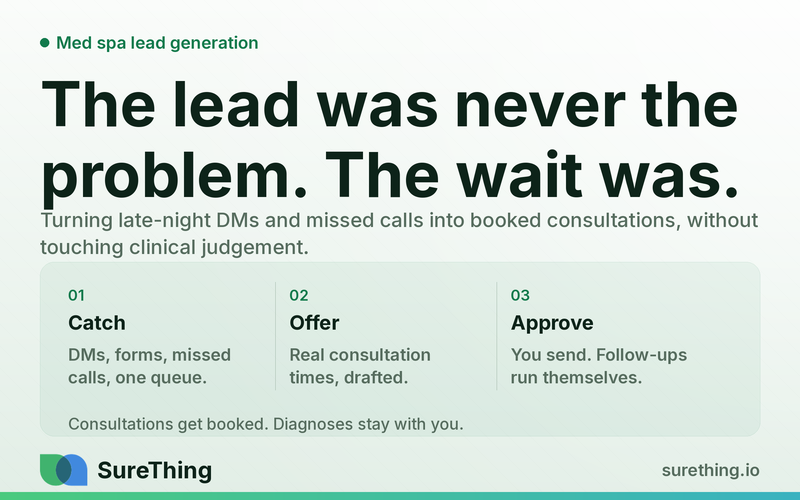
The loop worth automating is: inquiry lands, the agent reads which treatment and which source it came from, drafts a personalised reply offering concrete times, a human approves it, and no-shows and quiet leads get chased on a schedule nobody has to remember.
Reviews and referrals do more for a med spa than ad spend does, so the same loop should ask happy clients for a review at the right moment — and that ask has to stay honest to be worth anything.
Anything resembling a clinical opinion — whether a treatment suits a client, how their skin will respond, what to expect medically — never gets automated. The agent handles scheduling and logistics; the practitioner handles the judgement.
The Short Answer
Most med spas do not have a lead generation problem. They have a lead response problem that looks like one. Inquiries come in through Instagram DMs at 11pm, a contact form on the treatments page, a missed call during a facial, and a walk-in who asks a question and leaves without booking. Each one is a person who was interested enough to ask. What decides whether they become a client is not the ad that reached them — it is whether someone answers with a specific time before the interest cools. In an industry where a single treatment package can be worth four figures and the buying decision is emotional and personal, the gap between "asked a question" and "has a consultation booked" is where the revenue quietly leaks out. This article covers the loop that closes that gap: what triggers it, what the agent reads, what it drafts, where a human still has to say yes, and where the line sits that automation should never cross.
The Bottleneck Nobody Puts on a Whiteboard
Ask a med spa owner where they lose money and they will usually say marketing costs, or a competitor undercutting them on injectable pricing. Watch the actual week and a different picture emerges. The front desk is a treatment room half the day. The owner is also the primary injector. The person best qualified to answer "would this work for me?" is the person whose hands are busy for six hours at a stretch. So inquiries stack up in three or four different inboxes, and they get answered in a burst at the end of the day, or the next morning, or on Monday.
By then the person asking has usually done one of three things: booked somewhere else, decided the price was a no, or simply moved on with their week. None of those show up in a report. The lead was captured, the lead was contacted, and the lead did not convert — which reads, from a spreadsheet, like an audience problem rather than a timing problem. The distinction matters because the two have opposite fixes. An audience problem means changing the ads. A timing problem means changing who answers and how fast, which costs nothing in ad spend and is exactly the kind of work an agent absorbs well.
There is a second, subtler bottleneck: the consultation itself. Aesthetic treatments are not bought from a menu. In marketing terms, a lead is the contact information, and sometimes the demographic information, of someone interested in a specific product or service — but a med spa lead is interested in an outcome, not a SKU, and the treatment that delivers it has to be decided by a practitioner in person. That means the entire follow-up sequence has exactly one job: get a consultation booked at a specific time. Every message that tries to do more than that — quoting a price, promising a result, recommending a treatment — is both less effective and further outside what software should be deciding.
What the Agent Actually Reads
An agent is only as useful as the context it can see, and for a med spa the useful context is unglamorous. It reads the inquiry itself — the message text, which treatment page the form was submitted from, whether it arrived by DM or email or a missed call. It reads the calendar, so any time it offers is a time that genuinely exists. It reads the client record, if there is one, which is the part most practices underuse.
That client record is the difference between a reply that feels personal and one that feels like a template. CRM systems compile data from a range of communication channels — a company's website, telephone, email, live chat, marketing materials, and more recently social media, which is precisely the mess a med spa generates. When a returning client asks about a treatment, the agent should know they came in eight months ago for something else, and the draft should reflect that. When a stranger asks the same question, the draft should not pretend to a history that does not exist. Reading the record is what makes that distinction possible.
What the agent does not read is anything it has no business acting on. Clinical notes, intake forms, medical history: even where those are technically accessible, the follow-up loop does not need them to offer a consultation time, and pulling them into a drafting context invites exactly the kind of automated judgement this loop is built to avoid.
The Runnable Loop, Start to Finish
Trigger: an inquiry lands, on any channel
The trigger is the event, not a person checking. A form submission, a new DM, an unanswered call that leaves a number, an email to the practice address. All of them enter the same loop, which is the point — the reason inquiries get lost today is that each channel has its own inbox and its own inconsistent habit of being checked.
Read: match the inquiry to context
The agent pulls the message, the source page or channel, the calendar's genuinely open consultation slots for the next several days, and whatever client history exists. If the inquiry is ambiguous about what the person wants, that ambiguity is preserved rather than guessed at — a draft that asks one clarifying question converts better than one that assumes the wrong treatment.
Draft: a specific reply with specific times
The agent writes a reply that answers the logistical part of the question, acknowledges what the person actually asked, and offers two or three real consultation times. It does not quote treatment prices unless the practice has a fixed published price for that consultation. It does not say whether the treatment is right for them. It says, in effect: good question, that is what the consultation is for, here is when we could see you.
Nod: a human approves before anything sends
Every draft lands in a review queue, not an outbox. In practice this takes seconds per message — the reviewer is checking that the tone fits, the times are sensible, and nothing in the draft strays into promising an outcome. This is the human-in-the-loop arrangement in its most literal form: the system does the work, a person makes the call.
Routine: the parts that repeat without being asked
Once approved and sent, the loop keeps going on a schedule. A lead that does not reply gets a second, shorter follow-up after a few days. A booked consultation gets a reminder the day before, which is the single cheapest defence against no-shows. A completed treatment triggers a review request at the point the client is most likely to be happy about it. None of these require anyone to remember; all of them still require a human nod on the first contact with a new person.
Where the Reviews Come In
For a local aesthetic practice, reputation does more work than any single ad channel. Word-of-mouth marketing is communication between consumers about a product or service in which the sources are considered independent of direct commercial influence — that independence is the whole reason it carries weight, and it is also the reason automating it badly destroys the value. The same source is blunt about the failure mode: when companies use poor incentives to motivate consumers to spread positive word of mouth, the campaigns backfire.
So the automation here is narrow and deliberately unexciting. The agent notices that a treatment was completed, waits an appropriate interval, and drafts a plain request for a review — no incentive, no suggested wording, no star rating hinted at. A human approves it. That is the entire mechanism. It works because the timing is consistent, not because the message is clever.
The adjacent temptation is worth naming, because it is where practices get into trouble. Reputation management as a field has documented ethical grey areas that include astroturfing on review sites and the censorship of complaints. An agent that drafts review requests is useful. An agent that drafts responses designed to bury a negative review, or that routes unhappy clients away from public review platforms, is a liability dressed up as marketing. Keep the loop on the honest side of that line and it stays an asset.
What Runs Alone, What Waits for You, What Never Automates
Task | Automation level | Why |
|---|---|---|
Detecting a new inquiry across DM, form, email, missed call | Unattended | Pure observation; no outbound action, no risk in being fast |
Reading calendar availability and client history | Unattended | Read-only; makes every draft downstream more specific |
Drafting a first reply with consultation times | Unattended draft, human sends | First contact with a stranger sets the practice's voice |
Appointment reminders to a confirmed client | Unattended after first setup | Logistics only, already-agreed appointment, low downside |
Second follow-up to a lead who went quiet | Unattended draft, human sends | Tone matters more here than in the first message |
Review request after a completed treatment | Unattended draft, human sends | Must stay honest and un-incentivised to be worth anything |
Quoting a treatment price or package total | Human only | Depends on the consultation outcome, not the inquiry |
Advising whether a treatment suits a client | Never automated | Clinical judgement; belongs to a qualified practitioner, full stop |
Responding to a complaint about a treatment result | Never automated | Clinical and reputational risk in the same message |
Making It a Routine Instead of a Project
The failure mode for this kind of setup is not technical. It is that a practice automates six things in a week, cannot tell which one is working, and turns the whole thing off after a bad draft goes out. Start with one channel — whichever one currently gets answered slowest, usually Instagram DMs — and run the loop there for two weeks with every draft reviewed. Two things happen in that fortnight. The drafts get noticeably more specific to the practice, because every edit a reviewer makes is context for the next one. And the reviewer starts to see which categories of inquiry are safe to let through quickly and which always need a proper look.
Only then add the second channel. The measure of a good fortnight is not how many drafts were approved without edits; it is how few inquiries sat unanswered past the end of the day. Practices already running an AI follow-up loop for quiet leads or a new-patient follow-up sequence in a dental practice describe the same shift: the work did not vanish, but the part that used to eat a morning now takes a few minutes of review, and nothing waits until Monday.
FAQ
Will automated replies make the practice sound impersonal? They will if the drafts are templates. The reason to give the agent access to client history and the specific treatment page an inquiry came from is precisely so the draft is not generic — and because a human approves each first contact, an impersonal draft gets caught before it sends rather than after.
Can the agent book the consultation itself instead of offering times? It can offer real times and write the appointment once the client picks one, because that is logistics against a calendar it already read. What it should not do is rearrange an existing client's appointment or double-book a practitioner to fit someone in; those need a person who knows what the day actually looks like.
What about pricing questions, which is what most people ask first? Answer the part that is fixed and honest — consultation cost, whether packages exist, general ranges if the practice publishes them — and route the rest to the consultation. A specific quote before an assessment is a promise the practitioner may not be able to keep.
How does this differ from the auto-responder already built into the form tool? An auto-responder confirms receipt. This loop reads the inquiry, checks a real calendar, drafts a specific answer with specific times, and keeps following up on a schedule. The client-facing difference is that one says "we got your message" and the other says "here is when we can see you."
Does any of this need new software the practice does not already have? Usually not much. The loop reads the channels and calendar already in use; what is missing in most practices is not a tool but a consistent place for drafts to land and be approved.
Getting Started
Pick the channel where inquiries currently wait longest, and run the loop on that one alone for a fortnight with every draft reviewed. Watch one number: how many inquiries went unanswered past the end of the business day. If that number falls to near zero and the drafts stop needing edits, add the next channel. If it does not, the problem is upstream of the follow-up and worth finding before automating anything else — which is a more useful outcome than a dashboard full of loops nobody trusts.