September 8, 2026
Local SEO for Physical Therapists: Getting Found by Patients Who Have a Choice
PT clinics live between referrals and Google. A workflow for keeping listings, reviews, and multi-location profiles accurate - strictly on the marketing side, never touching clinical claims.
The Direct Answer
Local SEO for physical therapists means making sure that when a patient with a choice — a self-referring patient in a direct-access state, a patient checking whether their insurance network overlaps with your clinic, or a referral who Googles you before booking anyway — finds accurate hours, real reviews, and a Google Business Profile that hasn't gone stale for six months. It's less about chasing rankings and more about not losing patients you already earned through a referral relationship, simply because your online presence looked abandoned. The clinics that win this aren't doing anything exotic; they're just keeping their listings, reviews, and location pages current without it eating an afternoon a week.
Key Takeaways
Physical therapy sits in an unusual spot: you get referrals from physicians and you get self-referring patients doing their own Google research, especially in direct-access states — your local SEO has to serve both audiences at once.
A patient who has a choice of provider will typically check your Google Business Profile and recent reviews before calling, even if a physician already recommended you — consumer review research shows online reviews now weigh more heavily on local buying decisions than ever, and healthcare selection is no exception.
Multi-location clinics face a compounding problem: one neglected listing (wrong hours, an old therapist's name, a stale photo) can quietly undercut trust across an otherwise well-run group.
Insurance-network visibility — whether your listing and website clearly signal which plans you accept — is a local-search trust signal, not just an administrative detail.
Review response speed and consistency matter more for PT clinics than most verticals, because patients often mention pain, mobility, or family caregiving in reviews, and a generic or absent response reads as indifferent.
The fix isn't a bigger marketing budget — it's a light, recurring workflow that catches drift before a patient (or a referring office) notices it.
The Real Bottleneck: Nobody Owns the Listings Between Referrals
Most PT clinic owners didn't get into rehab to become part-time local SEO managers, and it shows. The typical setup is a front-desk staff member who handles Google Business Profile "when there's time," a practice manager who occasionally notices a review three weeks after it posted, and an owner who assumes referrals from physicians and orthopedic surgeons will keep the schedule full regardless of what Google shows.
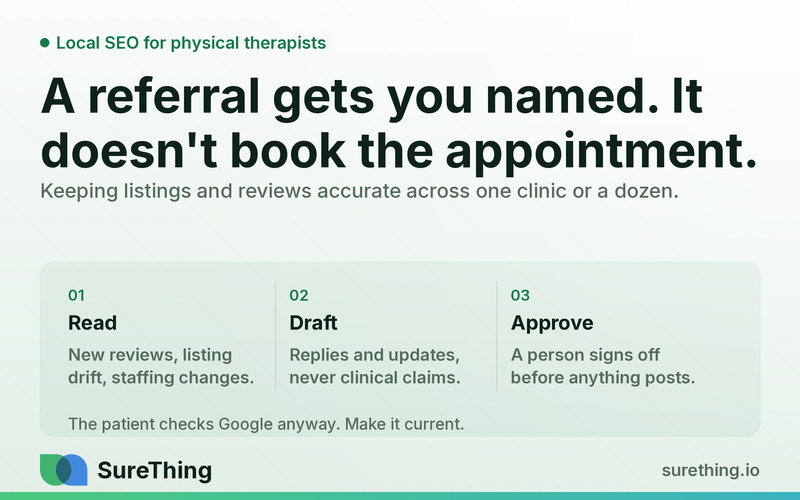
That assumption breaks down for two reasons specific to this industry. First, in states that allow direct access to physical therapy, a growing share of patients skip the referral step entirely and go straight to Google to find a physical therapist near them — which means your listing isn't a supplement to referral flow, it's a primary acquisition channel with its own conversion funnel. Second, even physician-referred patients frequently double-check the clinic online before calling to book, comparing hours, distance, parking, and reviews against two or three other options the referring office gave them. A referral gets you on the list; it doesn't get you the appointment.
The bottleneck, then, isn't a lack of marketing knowledge — it's that nobody has clear, recurring ownership of the unglamorous maintenance: updating hours around holidays, keeping each location's service list accurate as clinicians join or leave, responding to reviews before they go cold, and making sure a multi-location group doesn't have one clinic quietly falling behind the others. Add in the reality that many PT practices operate two, three, or a dozen locations under one brand, each with its own Google Business Profile, its own review stream, and its own local competitive set, and "we'll get to it" becomes "we never get to it." This is a slightly different flavor of the problem than a single-location retail business faces — the piece on building a daily local SEO habit covers the general cadence, but a multi-clinic PT group needs a workflow built around referral timing and per-location accuracy, not just a checklist repeated once.
A Runnable Workflow for PT Clinic Local SEO
Below is a workflow structured the way it would actually run, location by location, with a human still making the calls that require judgment or clinical sensitivity. This is the kind of loop a local SEO agent is built to carry, paired with a dedicated review monitoring agent for the review-specific pieces.
Trigger
The workflow doesn't wait for someone to remember it. It kicks off on a few predictable triggers: a new Google review or Google Q&A post appearing on any location's profile, a scheduled weekly listing audit across all clinics, a staffing change (a PT joining, leaving, or changing credentials) that needs to be reflected on the site and profile, or a seasonal event — a holiday closure, a new insurance panel joining, a new location opening. Each of these is a distinct, low-drama trigger, not a vague "check things periodically" instruction.
Read
Once triggered, the agent reads what's actually there before touching anything. That means pulling the current state of each location's Google Business Profile (hours, categories, services listed, attributes), scanning new reviews and their star ratings and text, checking whether recent reviews mention anything that needs a manager's eyes before a reply goes out, and cross-referencing the clinic's website location pages against the GBP listing to catch mismatches — a common failure point when a clinic updates its website but forgets the six other places its address and hours live. For groups running paid visibility alongside organic, this read step can also pull relevant Google Search Console or ads performance context so the team knows which locations are actually getting search impressions and which are invisible.
Does
With that context, the agent drafts — it does not publish unilaterally. It drafts responses to new reviews in a tone appropriate to physical therapy (professional, warm, never clinical, never confirming or discussing a patient's specific condition or treatment). It drafts updated GBP posts or service descriptions when a new clinician joins or a location adds capacity. It flags listing inconsistencies across directories — the address that's slightly off on one aggregator, the phone number that's outdated on another — and drafts the correction. It can also draft short social posts announcing a new team member or updated hours, and draft outreach notes to referring physician offices when something material changes, like a new location opening in their catchment area. None of this requires the agent to make clinical claims; it's strictly the marketing and operations layer — what the clinic is, where it is, who's there, and what patients are saying about the experience.
Nod
This is where a human stays firmly in the loop. Every drafted review reply gets a quick human read before it posts, especially for anything mentioning pain, a fall, a family member, or a negative experience — those need a practice manager's judgment, not an autopilot reply. Any change to insurance-panel information, credentials, or clinician bios gets verified against actual current records before publishing, since inaccurate insurance-network claims create real problems for patients trying to book. New location listings, category changes, and anything customer-facing that could be mistaken for a clinical statement all get an explicit approval step. The agent's job is to remove the friction of drafting and remembering — not to remove the person who understands the clinic's actual policies and current staff.
Routine
The habit that makes this stick is a short, recurring rhythm rather than a big quarterly cleanup. A daily glance at new reviews and Q&A across all locations, a weekly pass checking listing consistency and any pending drafts waiting for a nod, and a monthly review of which locations are underperforming in search visibility relative to their peers in the same group. For groups running two or more clinics, this monthly pass is where an owner catches the one location that's been drifting — wrong hours for three months, no new reviews responded to — before it shows up as a soft patch in that clinic's schedule.
Manual vs. Automated: What Actually Changes
Task | Manual Approach | Agent-Assisted Approach |
|---|---|---|
Responding to Google reviews | Front desk replies when they remember, often days later, with inconsistent tone across staff | Draft reply generated shortly after the review posts, reviewed and approved by a manager before publishing |
Keeping multi-location hours/services accurate | Updated ad hoc, usually after a patient complains about a wrong hour or missing service | Weekly audit flags mismatches across locations and directories before a patient notices |
Reflecting clinician changes (new hire, departure) | Website and GBP updated whenever someone thinks of it, sometimes weeks later | Triggered update drafted as soon as a staffing change is logged, approved, then published everywhere at once |
Insurance-panel visibility | Buried in a PDF or a phone-only answer, invisible to someone searching on Google | Kept current on the listing and site copy, with any factual insurance claim confirmed by staff before it goes live |
Tracking search visibility across locations | Rarely checked unless one clinic is visibly slow | Monthly comparison across locations surfaces the one falling behind before it becomes a revenue problem |
Where the Line Should Be
What can run unattended
Monitoring — pulling in new reviews, tracking listing consistency across locations and directories, watching for GBP field changes competitors or Google itself might trigger, and compiling weekly or monthly summaries of what's changed — can run continuously without a human checking in on each pass. Drafting is also safe to let run in the background, as long as nothing drafted publishes itself. An agent quietly noticing that Location 3's hours don't match its website, or that a new review came in overnight, is pure upside with no downside as long as it stops short of acting alone.
What needs a human nod
Publishing anything patient-facing needs a person to sign off first: review replies, GBP post updates, changes to insurance or credential information, and any new-location announcements. This isn't caution for caution's sake — a wrong insurance claim or a tone-deaf reply to a review about a difficult recovery is the kind of mistake that's hard to walk back once it's public, and it's exactly the kind of thing a busy owner would rather catch in thirty seconds of review than explain later.
What should never be automated
Nothing that touches clinical judgment, treatment outcomes, or specific patient conditions should ever be drafted or published by an automated system — full stop. That includes any language implying efficacy of a treatment approach, any response to a review that references a patient's diagnosis or progress, and anything that could be read as medical advice. Similarly, decisions about which insurance panels to join, how to price cash-pay services, or how to structure a multi-location business legally are operational and financial decisions for the owner and their advisors, not something a marketing workflow should influence. This workflow stays entirely in the lane of findability, accuracy, and reputation — not clinical care.
FAQ
Does local SEO matter if most of my patients come from physician referrals?
Yes, because a referral gets a clinic named — it doesn't guarantee the appointment gets booked. Patients frequently check the clinic online before calling, even when a physician handed them the name directly, and an outdated or unresponsive-looking profile can quietly cost you patients who were already inclined to choose you.
How is this different for direct-access states versus referral-based states?
In direct-access states, patients can self-refer to a physical therapist without a physician's order, which means your Google Business Profile and reviews often function as the entire first impression, not a supplement to a referral. The fundamentals — accurate listings, responsive reviews, clear insurance information — matter everywhere, but the stakes are higher where self-referral is common.
What's the biggest risk with multi-location clinic listings?
Inconsistency between locations. One clinic with outdated hours, unanswered reviews, or a stale service list can drag down trust for the whole group, especially when patients compare locations before choosing which one is closest or has availability.
Should we mention insurance networks in Google Business Profile or review replies?
You can make sure your website and listing clearly state which plans you're in-network with, since that's a real factor patients search for, but always have that information verified by staff before publishing — insurance panel status changes and needs to stay accurate, not just search-friendly.
Can review replies be automated entirely?
They can be drafted automatically, but publishing should always go through a quick human approval, particularly for physical therapy, where reviews often reference pain, mobility, falls, or family caregiving — situations that deserve a human's judgment before a public reply goes out.
Where to Go From Here
None of this requires an overhaul of how your clinic markets itself — it just requires that the unglamorous parts of local visibility stop depending on someone remembering to do them between patients. A workflow that reads your listings and reviews on a schedule, drafts the responses and updates, and hands the final call back to a person is closer to hiring a careful assistant than to "doing marketing." If you're weighing whether this kind of setup makes sense for a multi-location group, or you're curious how it compares to the way other local-service businesses — like the approach outlined for med spa lead generation — handle the same kind of listing and review upkeep, it's worth a look at what a dedicated local SEO workflow can quietly take off your plate.