August 20, 2026
Local SEO for Contractors: Automating the Work Behind the Checklist
Every local SEO guide for contractors tells you what to do -- GBP posts, review requests, citations. See how an AI agent actually runs it for you, job by job.
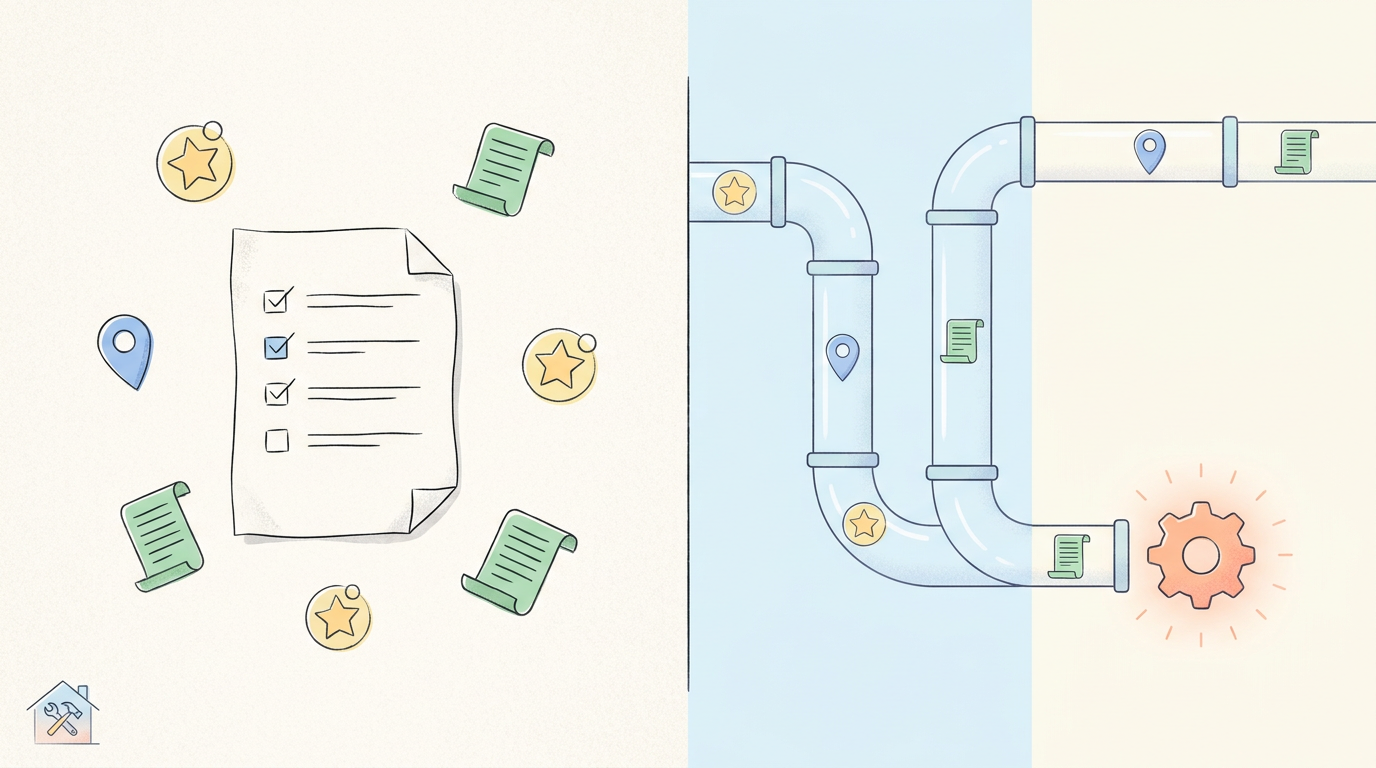
Every local SEO guide for contractors says the same six things: fix your Google Business Profile, get more reviews, clean up your citations, build service-area pages, earn local links, keep posting. All true. None of it says who's going to actually do this between jobs.
Local SEO for contractors is the compounding, unglamorous work of showing up first in the map pack for "near me" searches — and the reason it stalls usually isn't strategy, it's staffing. An AI agent can run the repeatable half of that checklist — review requests, Google Business Profile posts, citation checks, rank tracking — so the owner only shows up for the calls that need a human.
Key takeaways
Local SEO for contractors runs on six well-known pillars: Google Business Profile, reviews, citations, service-area pages, local links, and ongoing content.
Most guides stop at "do this monthly" — none tie the work to the thing that actually triggers it: a job getting finished.
An AI agent can turn "job completed" into a drafted review request, a drafted GBP post, and a citation check automatically — with the owner approving before anything goes out.
Rank and competitor tracking catches threats (a competitor's new reviews, a dropped map-pack position) before they cost bookings.
The owner still owns judgment calls: brand voice, pricing boundaries, which customers get a personal callback, and when to expand into a new service area.
The checklist every contractor already knows
If you've searched "local seo for contractors," you've read some version of this list already:
Google Business Profile — complete every field, upload real job photos, post weekly. A complete profile gets roughly seven times more clicks than an incomplete one.
Review velocity — a steady 3–5 new reviews a month beats a burst of 20 followed by silence. Map-pack algorithms reward consistency.
Citations and NAP consistency — your name, address, and phone number need to match, exactly, across every directory that lists you.
Service-area pages — a real page per city or neighborhood you serve, not one page that lists twelve towns in a footer.
Local links — suppliers, manufacturers, the chamber of commerce, local sponsorships.
Ongoing content — seasonal posts, FAQ pages, the stuff that keeps a profile looking active.
None of that is wrong. It's also not new — you could have written this list from memory. The part every guide skips is who runs it every week, forever, without turning into a second job.
Why the checklist stalls
Not because contractors don't believe in local SEO. Because the work doesn't fit on a calendar reminder.
A review request sent three weeks after a job closes reads as an afterthought — and gets ignored. A GBP post written once a month, disconnected from any real job, reads as filler — and gets skipped by customers scanning search results. A citation drifts out of sync on one directory and nobody notices for months, because checking twelve directories by hand isn't a task anyone volunteers for.
The fix isn't a better checklist. It's tying each task to the event that should trigger it — a job finishing, a new review landing, a competitor's profile changing — instead of a date on a calendar.
What running it on autopilot actually looks like
Here's the workflow, mapped to five job-triggered steps instead of a monthly to-do list:
Job marked complete. Whatever you already use to track jobs — a field service tool, a shared spreadsheet, a text to the office — is the trigger.
Review request drafted, not sent blind. The agent writes a short, job-specific request ("Thanks for letting us fix that water heater today, Sarah") and puts it in front of you or your dispatcher to approve before it goes out.
The same job becomes a GBP post draft. A photo plus two sentences about the work — approved before it's public, so nothing goes out in your name that you haven't seen.
Citations get checked weekly, not annually. The agent flags any directory where your name, address, or phone has drifted, and you approve the fix.
Rank and competitor moves get tracked continuously. If a competitor picks up a run of new reviews or you slip out of the map pack for a core term, you hear about it that week — not next quarter.
Nothing here replaces judgment. It replaces the twelve small, repetitive tasks that judgment was never required for in the first place.
What stays yours
Brand voice. The agent drafts in your tone; you approve or edit before anything is public.
Which customers get a personal callback. A rushed job, a difficult install, a customer who seemed unhappy on-site — those still get a phone call from you, not an automated request.
Pricing and service-area boundaries. The agent tells you where the opportunity is; you decide whether to chase it.
When to expand. New city, new neighborhood, new trade line — that's a business decision, not an automation.
FAQ
How is this different from just hiring a local SEO agency?
An agency plans the strategy and hands you a monthly report. An AI agent runs the day-to-day execution — the review requests, the posts, the citation checks — tied to your actual jobs, and asks for your approval before anything publishes. You can use both; they solve different problems.
Do I need a fancy field service platform for this to work?
No. The trigger can be as simple as marking a job "done" in whatever system you already use, including a shared spreadsheet or a message to the office.
What if I don't want every review request or post to be automatic?
Nothing publishes without your sign-off. The agent drafts; you approve, edit, or skip. That approval step is the whole point — it's what keeps the automation from turning into a liability.
How long before this shows up in the map pack?
Local SEO compounds — most contractors see early movement in secondary keywords within a couple of months, with the primary map-pack terms following over six to twelve months. Automation doesn't skip that timeline; it just means the work behind it actually happens every week instead of in bursts.
We built SureThing for exactly this kind of work — the parts of running a business that are simple in theory and never get done in practice because there's no one to do them between jobs. If you want to see what a job-triggered AI agent looks like for your trade, our pricing page has the plans, and our post on how AI agents handle the repetitive parts of customer service covers the same approve-before-it-ships model in a different part of the business.