September 16, 2026
Local SEO Audit: The Checklist an AI Agent Can Actually Run For You (2026)
A local SEO audit finds what's broken before any daily checklist has something to check. Here's exactly what an agent can scan on its own, and where you still have to decide.
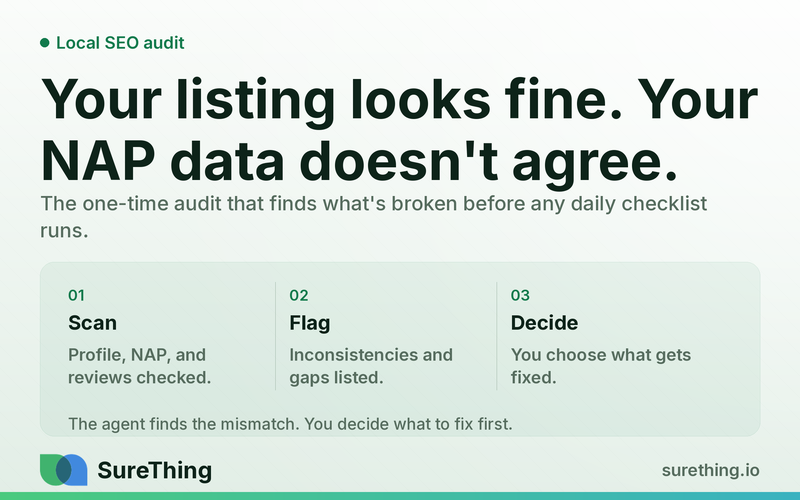
A proper local SEO audit answers one question: is your business actually set up to win the searches that turn into phone calls and walk-ins right now, today - not six months ago when you or someone else last touched your Google Business Profile? It checks your listing completeness, whether your name, address, and phone number match everywhere you're listed, how your reviews look and how fast you respond to them, whether you actually show up in the local map pack for the searches that matter, and whether the technical basics on your site are holding you back. Most small business owners have never run one formally, which means most small businesses are quietly losing visibility to problems nobody has ever looked for.
Key Takeaways
A local SEO audit is a one-time or quarterly diagnostic pass that finds what's broken - it's a different job from a daily checklist that keeps things from breaking once they're fixed.
"NAP consistency" simply means your business Name, Address, and Phone number are typed the exact same way on every directory, map, and listing where they appear.
An AI agent can read and flag inconsistencies, missing profile fields, review response gaps, and ranking drops on a recurring schedule - it doesn't need a human to babysit the checking part.
Some decisions still need a person: claiming a newly discovered location listing, replying to a review with legal or reputational risk, and changing NAP on paid directories that cost money to edit.
The audit's real output isn't a score - it's a prioritized punch list of what to fix first, handed to a human who decides, not a robot that decides for you.
Once the audit clears the backlog, the daily local SEO checklist is what keeps new problems from piling back up.
The real bottleneck: nobody owns "checking," so nothing gets checked
Here's what actually happens inside most small businesses. Someone - the owner, a manager, a cousin who's "good with computers" - set up the Google Business Profile two or three years ago. They picked categories, wrote a description, uploaded a few photos. Then life happened. The business moved half a mile, or added a service, or changed its phone system, or a former employee who had admin access left and the login got lost. Meanwhile, the business also has listings on Yelp, Apple Maps, Facebook, industry directories, the Chamber of Commerce site, and a data aggregator nobody remembers signing up for. Each of those was filled in once, by someone, at some point, and never touched again.
The bottleneck isn't a lack of knowledge about what "good" local SEO looks like - most owners have a rough sense that Google reviews matter and that showing up on the map is good for business. The bottleneck is that checking whether everything still matches, is still accurate, and is still ranking is tedious, unrewarding, low-visibility work with no obvious deadline pushing it forward. It's the kind of task that's always "next week" because nothing visibly breaks the day it's neglected - it just slowly costs you calls, one mismatched phone number and one un-answered review at a time.
This is also why an audit and a daily checklist are not the same thing, even though they sound similar. The daily local SEO checklist assumes your foundation is already correct and simply prevents new drift - new reviews get answered, new posts go out, rankings get watched week over week. An audit is the opposite motion: it goes backward first, digs through everything that's already there, and surfaces what's broken, missing, or inconsistent before any daily routine has something clean to maintain. If you've never run a formal audit, running the daily checklist on top of an uncorrected foundation just means you're diligently maintaining a mess. This piece is about the diagnostic pass that comes first.
What a real local SEO audit actually checks
Before getting into workflow, it helps to know what's actually inside a competent audit, because "SEO audit" gets used loosely enough to mean almost anything. A proper local SEO audit for a small business covers six areas:
Google Business Profile completeness
Is the category correct and specific? Are hours accurate, including holiday hours? Is the description filled in, keyword-relevant, and not just copied boilerplate? Are there recent photos? Is the "products/services" section populated? Missing fields aren't cosmetic - they're missed opportunities for Google to match you to a search.
NAP consistency across directories
NAP stands for Name, Address, and Phone number - and "consistency" means those three things are written identically everywhere your business appears online, not just roughly similar. "123 Main St, Suite 4" on your website but "123 Main Street #4" on Yelp and an old address on a directory you forgot existed is an NAP inconsistency. It sounds minor, but Google and other platforms use NAP matching as a trust signal - if your business's identity looks different in different places, it's harder for search engines to confidently connect the dots and rank you as the authoritative, real, single business you are.
On-page local signals
Does your website actually say your city and service area in the text, not just in a footer? Do you have a page (not just a paragraph) for each core service, ideally tied to a location? Is your address in the footer and does it match your NAP everywhere else?
Review volume, recency, and response rate
How many reviews do you have relative to competitors, how recently did the last one come in, and - critically - how many of them have a response from the business? Response rate is one of the most neglected and most fixable signals in local SEO.
Local pack ranking for core service + city queries
Where do you actually show up when someone searches "[your service] + [your city]"? Not your brand name - the generic query a stranger would type. This is the scoreboard everything else feeds into.
Technical basics
Mobile page speed, whether your site is actually mobile-usable (not just "not broken"), and whether basic local business schema markup is present so search engines can read your business details programmatically rather than guessing from page text.
Research on local search behavior consistently shows that consumers use these exact signals - profile completeness, review recency, and consistent business information - to decide which business to actually call, which is why independent research on local search consumer behavior is worth understanding even at a high level before you assume your listings are "probably fine."
The workflow: how a recurring agent actually runs the audit
An audit doesn't have to mean a consultant with a clipboard and a $2,000 invoice. Most of the checking work above is mechanical - it's reading data from multiple sources and comparing it against what it should say. That's exactly the kind of work a scheduled AI agent can do reliably, as long as a human stays in the loop for the decisions that carry real cost or risk. Here's what that looks like end to end.
Trigger
The audit doesn't need a person to remember it exists. It runs on a schedule - quarterly is typical for most small businesses, monthly if you're actively fighting for rankings in a competitive category, or on-demand right after something changes: a move, a rebrand, a new service line, or a noticeable drop in calls. The trigger can also be reactive - a sudden dip in map pack visibility flagged by ongoing SEO monitoring can itself kick off a full audit pass rather than waiting for the calendar.
Read
Once triggered, the agent pulls and reads: the current Google Business Profile fields, the business's listings across major directories (Yelp, Apple Maps, Bing Places, Facebook, and whatever industry-specific directories are relevant), the website's local pages and schema markup, the review feeds across platforms, and current local pack positions for a defined list of core service-plus-city search terms. It also reads mobile page speed reports and basic Google Search Console signals for the site's local landing pages. None of this requires judgment yet - it's information gathering, and it's exactly the kind of repetitive, multi-source pull that's tedious for a person and trivial for an agent to run consistently.
Does
This is where the agent turns raw reads into something useful. It compiles a discrepancy list - every place the NAP doesn't match, field by field, directory by directory. It drafts the corrected, standardized version of the business's NAP to use as the single source of truth going forward. It flags every Google Business Profile field that's empty or outdated and drafts suggested copy for the description and services sections. It calculates review response rate and drafts suggested replies for any unanswered reviews sitting there. It builds a ranked list of which core service-plus-city queries the business is winning, losing, or absent from entirely, and it drafts a short prioritized punch list - ordered by likely impact and ease of fix - rather than a wall of raw data. This is also the stage where it can draft an outreach note to a directory that requires a manual correction request, ready for a human to send.
Nod
Nothing goes live without a human glance at the parts that matter. The owner or manager reviews the draft review responses before they post - especially anything with a complaint, a refund mention, or language that could be read as an admission of fault. They approve the corrected NAP before it's pushed anywhere, since a wrong "fix" is worse than the original inconsistency. They decide whether a newly discovered directory listing should actually be claimed, verified, and maintained, or whether it's low-value and worth ignoring. And they sign off before any paid directory listing gets edited, because those changes often cost money or require a subscription renewal to unlock.
Routine
The audit itself isn't daily - that's the point of separating it from the daily checklist. But its output feeds directly into one: once the punch list is worked through and the foundation is clean, the business hands ongoing maintenance to a standing routine, like the one described in the daily local SEO checklist, so new reviews get watched, new inconsistencies get caught early, and the business doesn't drift back into needing another full audit in six months. Think of the audit as the deep clean and the daily routine as taking the trash out every night so the deep clean doesn't have to happen as often.
Manual audit vs. agent-run audit: what actually changes
Task | Manual approach | Agent-assisted approach |
|---|---|---|
Checking NAP across directories | Owner opens each directory one by one, compares by eye, often misses subtle differences (abbreviations, old suite numbers) | Agent pulls listing data from each source and compares field-by-field against a defined source of truth, flags every mismatch automatically |
Google Business Profile completeness | Skimmed occasionally, gaps go unnoticed for months or years | Agent checks all fields on a schedule and drafts fill-in content for anything missing, ready for approval |
Review response tracking | Owner responds when they remember, no visibility into overall response rate | Agent calculates response rate and recency, drafts replies for unanswered reviews, surfaces the ones needing careful human wording |
Local pack ranking checks | Owner Googles their own business occasionally from their own phone, which shows personalized/biased results | Agent checks defined service+city queries from a neutral standpoint on a consistent schedule and tracks movement over time |
Technical/schema checks | Rarely checked at all unless the site was recently rebuilt | Agent pulls mobile speed and schema presence as part of the same audit pass, flags issues alongside the local signals |
Turning findings into action | Findings sit in a spreadsheet or the owner's head, often never acted on | Agent produces a prioritized punch list ready for a quick human decision, not just raw data |
Where the line actually is: what should run on its own, what needs a nod, what should never be automated
The honest answer to "can AI just run my local SEO audit?" is: it can run almost all of the checking, and none of the deciding that involves money, legal exposure, or reputation. Being specific about that line is what makes the automation trustworthy rather than reckless.
Can run unattended
Pulling and comparing NAP data across directories on a recurring schedule
Checking Google Business Profile field completeness and flagging gaps
Tracking review volume, recency, and response rate over time
Checking local pack rankings for a defined list of service-plus-city queries
Pulling mobile speed and schema presence reports
Compiling all of the above into a single prioritized punch list
Needs a human nod
Approving a drafted correction to NAP before it's pushed live anywhere
Approving drafted review responses before they post, especially anything touching a complaint or refund
Deciding whether a newly discovered listing is worth claiming and verifying, or safe to ignore
Approving any change to a paid directory listing, since those often carry renewal costs or contract terms
Deciding how to prioritize the punch list when time or budget is limited
Should never be automated
Responding to a review that alleges something with legal exposure (safety incidents, discrimination claims, threats of legal action) - that needs a person, and often needs input from whoever handles the business's legal or insurance questions, not an AI-drafted public reply
Making claims in Google Business Profile descriptions or review responses about outcomes, cures, guarantees, or results the business can't actually stand behind
Deciding to abandon or merge business locations/listings without a human confirming which one is actually correct - a wrong automated merge can tank visibility for a real location
None of this is about distrust of the technology - it's about matching effort to risk. Checking a phone number against a directory has almost no downside if it's slightly wrong for a day. Publishing a reply to a one-star review about a safety complaint has real downside if it's worded badly. A well-built agent workflow, like the ones described across AI agents built for small business needs in 2026, is designed around that distinction rather than pretending everything is equally low-stakes.
FAQ
How often should a small business run a local SEO audit?
Quarterly is a reasonable default for most small businesses, with an additional audit triggered any time something changes - a move, a rebrand, a new service, or a sudden drop in calls or map visibility. Businesses in highly competitive local categories sometimes run it monthly.
What's the difference between this audit and the daily local SEO checklist?
The audit is the diagnostic pass that finds what's broken, missing, or inconsistent - it's meant to run occasionally, not daily. The daily checklist is what keeps things clean afterward, so new problems get caught early instead of piling up into another audit-sized backlog. You generally want to run the audit first, at least once, before leaning on a daily routine - otherwise the daily routine is just maintaining a foundation that was already broken.
What does "NAP consistency" actually mean in practice?
It means your business Name, Address, and Phone number are written the exact same way - same abbreviations, same suite number format, same phone format - across every place they appear: your website, Google Business Profile, Yelp, Facebook, industry directories, and anywhere else your business is listed. Small differences that seem trivial to a human reader can register as inconsistency signals to search engines.
Can an AI agent claim a new business location or directory listing on its own?
No, and it shouldn't. Claiming and verifying a listing usually involves confirming ownership through a phone call, postcard, or email tied to the business, and it can have downstream effects on which listing becomes the "master" record. That decision, and the verification step itself, needs a human.
Will fixing NAP and profile issues actually improve rankings?
It removes friction that can hold rankings back - consistency and completeness are trust signals search engines use to confirm a business is legitimate and current - but they're one input among several, alongside reviews, on-page content, and links. General industry guidance on local ranking factors, such as published analysis of local search ranking factors, consistently places profile accuracy and review signals among the most controllable levers a small business actually has, which is a big part of why the audit is worth doing even without a guaranteed ranking jump.
Where to start if you've never done this before
If you've read this far and realized you genuinely don't know what your NAP looks like across five different directories, that's normal - almost nobody does until they look. The point of a local SEO audit isn't to hand you a scary report card; it's to hand you a short, prioritized list of specific things to fix, in order, so the next few hours of work actually move the needle instead of being another vague "improve our SEO" to-do that never gets scheduled.
A recurring agent can do the reading, comparing, and drafting - the parts that are tedious but not risky - and leave the deciding to you: which reviews to respond to personally, which listings are worth claiming, which paid directory changes are worth the money. That split is the whole idea behind how SureThing agents are built for small business marketing work, including the ongoing local SEO monitoring that picks up right where an audit leaves off. If you're curious what that looks like for a business your size, the pricing page lays out the plans without requiring a sales call, and running one audit is a reasonable, low-pressure way to see whether the ongoing routine is worth setting up next.