September 8, 2026
Gym Marketing Automation: Filling Classes and Keeping Members From Quietly Cancelling
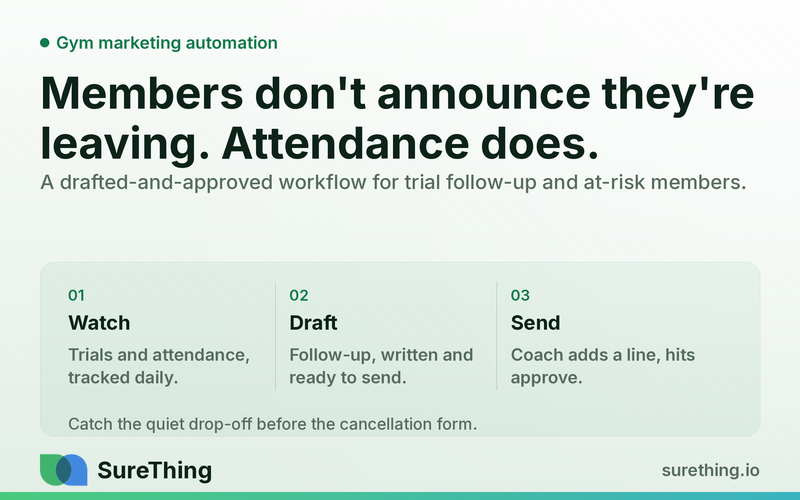
Gyms lose members two ways: trial leads who go cold before their first class, and members who disengage for weeks before they cancel. A drafted-and-approved workflow for catching both.
The Short Answer
Gym marketing automation works when it handles the two leaks that cost boutique fitness studios the most members: trial leads who go cold before they ever show up to class, and current members who quietly disengage for weeks before they cancel. The fix isn't more software dashboards — it's a workflow where an AI agent drafts the timely follow-up and the flagged outreach, a human approves the message before it goes out on anything sensitive, and the whole thing runs as a daily habit instead of a one-time campaign.
Key Takeaways
Most gyms lose trial leads not from bad marketing, but from slow or nonexistent follow-up in the 24-72 hours after sign-up.
Member churn rarely happens suddenly — it shows up first as a pattern of missed classes, and almost no front desk team has time to track that pattern manually.
Automation should draft the follow-up and flag the at-risk member; a coach or owner should still be the one having the actual conversation.
A workflow needs five parts to actually run: a trigger, what the agent reads, what it drafts or does, where a human approves, and how it repeats on a schedule.
The goal isn't replacing the front desk — it's making sure no lead or lapsing member falls through the cracks between classes, front desk shifts, and slow weeks.
Some things — refund decisions, medical/injury conversations, contract disputes — should never be automated, no matter how good the tooling gets.
The Real Bottleneck: Attention, Not Effort
Ask any gym owner what's broken in their marketing and you'll usually get one of two answers, and they're rarely about ad spend or class programming. The first is: "People book a trial class and then we never hear from them again — they just don't show." The second is: "We don't find out someone's cancelling until they're already cancelling."
Both problems come from the same root cause: a busy studio doesn't have a dedicated person whose only job is watching for these signals. The front desk is checking people in, the coach is coaching, and the owner is doing payroll, scheduling substitutes, and trying to keep the Instagram feed alive. Nobody is sitting there tracking which trial leads haven't been texted back, or which member hasn't shown up in three weeks. It's not a motivation problem — it's an attention problem, and attention is the scarcest resource in a small studio.
This is different from a generic "follow up faster" problem you'd see in, say, a dental practice chasing new patients or a med spa chasing consultation bookings. A gym's sales cycle is compressed into a single free or paid trial class, often scheduled within days of sign-up, and the "product" being sold is partly the workout and partly the community feel of walking into a room full of strangers. If nobody reaches out between booking and the actual class, the lead's motivation evaporates — they forget, they get nervous, or a cheaper big-box gym's ad shows up in their feed first. And on the retention side, a lapsing member doesn't announce themselves. They just start showing up less, and by the time the cancellation form comes through, the decision was made weeks earlier.
Solving this by hiring more front desk hours isn't usually realistic for a studio running on tight margins. That's the gap that marketing automation for gyms is actually meant to close — not "more marketing," but consistent attention on the two moments that quietly decide revenue: the gap between trial sign-up and trial class, and the gap between a member's last good week and their cancellation.
A Runnable Workflow: Trial Follow-Up and At-Risk Member Outreach
Below is a workflow built around the five stages that make automation actually usable in a small gym, rather than another dashboard nobody logs into. This is close to how a lead generation agent can be configured for a fitness business — it's not about auto-blasting people, it's about making sure the right message goes out at the right moment, drafted for a human to send or approve.
Trigger
Two separate triggers run in parallel for this workflow, because they're solving two different leaks.
Trial lead trigger: Someone books a trial class through your booking software, fills out a web form, or DMs the studio's Instagram asking about a first class. The moment that booking or inquiry lands, the clock starts.
At-risk member trigger: A member's attendance drops below their normal pattern — say, someone who usually comes three times a week hasn't checked in for two weeks — or a membership is flagged as "up for renewal" within the next 30 days.
Read
Before drafting anything, the agent needs context, or the message will read like spam. For the trial lead, it checks: which class did they book, is it a beginner-friendly slot, has the studio texted or emailed them already, and what class times are actually open this week. For the at-risk member, it reads: attendance history over the last 60-90 days, membership tier and renewal date, and any recent notes from staff (injury mentioned to a coach, a schedule change, a complaint logged at the desk). This is the same principle used in AI-driven lead follow-up for other service businesses — the agent isn't guessing, it's reading the actual account history before it writes a word.
Does
With context in hand, the agent drafts — it does not send anything on its own for anything that touches money, cancellation, or a first personal impression. For trial leads, it drafts a short, warm confirmation message reminding them what to bring and what to expect, then a second follow-up drafted for if they don't show, and a third check-in drafted for the day after their trial asking how it went. For at-risk members, it drafts an outreach note flagged for the coach or owner — something like a heads-up that a specific member hasn't been in for two weeks, with a suggested personal check-in message the coach can send in their own voice, not a form email. The agent can also draft a short social post or story prompt encouraging lapsed members to come back to a specific class time that has open spots, feeding into whatever your studio is already doing with social media scheduling.
Nod
This is the step that keeps the workflow from feeling like a robot ran your gym. Every drafted message — the trial reminder, the no-show follow-up, the at-risk check-in — sits in front of a human before it goes out. For trial leads, the front desk or owner glances at it and hits send, or tweaks the class time if something changed. For at-risk members, the coach who actually knows that person reads the draft, adds a personal line ("hey, saw you at the 6am a lot last month, everything okay?"), and sends it themselves. The agent's job is to make sure the draft exists and is ready in under a minute; the human's job is to make sure it sounds like a person who actually cares, because in a small studio, that relationship is the entire product.
Routine
None of this works as a one-off campaign — it has to become a standing habit that runs whether or not anyone remembers to check it. A practical cadence looks like:
Daily: Trial lead check — any new sign-ups get a drafted welcome/confirmation queued for approval same-day; any no-shows from yesterday get a drafted follow-up queued.
Daily or every other day: Attendance scan — the agent flags anyone whose check-in pattern has quietly dropped, and queues a drafted outreach note for the coach.
Weekly: Renewal scan — anyone renewing in the next 30 days gets flagged with a drafted "how's it going" or loyalty note ahead of the renewal date, not just a billing notice.
Weekly: A short review where the owner glances at what got sent, what got skipped, and adjusts the drafts' tone or timing if something felt off.
Industry data on member behavior backs up why the timing matters this much — research tracking attendance data across thousands of fitness-center members generally shows that engagement drops well before a formal cancellation, which is exactly why waiting for the cancellation request to act is too late.
Manual vs. Automated: What Actually Changes
Task | Manual Approach | Automated Workflow |
|---|---|---|
Trial lead follow-up | Front desk remembers to text/email when they have a spare minute, often a day or two late | Drafted confirmation and reminder queued within minutes of sign-up, ready for one-click approval |
No-show trial leads | Often forgotten entirely once the class time passes | Automatically flagged with a drafted re-engagement message the same day |
Spotting a lapsing member | Noticed by accident, usually only if a coach happens to remark on it | Attendance pattern flagged automatically, drafted check-in queued for the coach |
Renewal conversations | Handled reactively when the billing system sends a notice | Flagged 30 days ahead with a drafted personal check-in, not just a billing reminder |
Class-fill visibility | Owner eyeballs the schedule and guesses which slots are underbooked | Underbooked slots flagged with a drafted social post or targeted outreach to fill them |
Where the Line Should Be
What can run unattended
Scanning attendance logs for pattern changes, checking booking systems for new trial sign-ups, pulling renewal dates from your membership platform, and drafting the first version of a message — all of this can run in the background without anyone watching it happen. It's low-risk because nothing goes out to a real person until a human looks at it.
What needs a human nod
Every outbound message to a lead or member needs a human glance before it sends — trial confirmations, no-show follow-ups, at-risk check-ins, renewal notes. Even a short draft can misjudge tone (nobody wants a chipper "we miss you!" text right after they mentioned an injury to a coach), so a five-second read-and-send step stays non-negotiable. Social posts drafted to fill an underbooked class should also get a quick look before publishing, since studio voice matters more than most business categories.
What should never be automated
Anything involving a member's health status, injury, or fitness-to-train decisions stays entirely with your coaching staff — this is a coaching and, where relevant, medical judgment call, not a marketing one. Refund and cancellation-fee decisions, contract disputes, and any billing dispute should go through a human with authority to make that call, not an automated message. And nothing here should be read as legal, tax, or insurance guidance for how you structure memberships or waivers — that's a conversation for your own advisor, not a marketing workflow.
FAQ
Will automating follow-up make our gym feel less personal?
It shouldn't, if it's set up the way described above — the agent drafts, a real person edits and sends. The risk of feeling impersonal comes from sending unedited form messages, not from having a draft ready faster.
How is this different from the email sequences my booking software already sends?
Most booking platforms send the same generic sequence to everyone regardless of context. This workflow reads actual attendance and lead behavior first, so the drafted message reflects what actually happened — a no-show gets a different message than someone who showed up and loved it.
Do we need a big member base for this to be worth setting up?
No — if anything, small studios benefit more, because losing even a handful of members to quiet disengagement is a noticeable revenue hit. The workflow scales down fine; it just runs on fewer flags per week.
Can this replace our front desk or sales role?
No, and it's not meant to. It removes the "did we remember to follow up" burden so the people at the desk and on the floor can spend their time actually talking to leads and members instead of chasing a spreadsheet.
What if we don't have attendance tracking set up in our software?
Most modern class-booking platforms log check-ins by default, which is enough of a data source to start flagging attendance drops. If yours doesn't, that's usually the first gap worth closing before layering on automation — even a simple check-in sheet, digitized, gives the agent something to read.
Where to Go From Here
If either of these leaks sounds familiar — trial leads going quiet, or members disappearing before anyone notices — it's worth mapping out what your studio's version of this workflow would actually look like before you buy anything. Some studios start with just the trial follow-up piece, since it has the most direct line to revenue; others start with attendance monitoring, since that's the leak that's harder to see. Either way, the pattern that tends to work is the same one described here: an overview of AI adoption trends across the fitness industry confirms this is becoming standard practice rather than a novelty, but the specifics of what to automate first should match your own class schedule and staffing, not a generic template. If you want to see how a setup like this could fit your studio without turning your coaching staff into robots, looking at how other service businesses structure similar follow-up workflows is a reasonable place to start, and SureThing's agents are built to handle exactly this kind of drafted-and-approved workflow when you're ready to try one.