September 16, 2026
Local SEO Reporting: Getting a Straight Answer on 'Is It Working' Without a Manual Spreadsheet (2026)
A recurring local SEO report shouldn't take an afternoon of copy-pasting from three dashboards. Here's what it should contain and what an agent can assemble on its own.
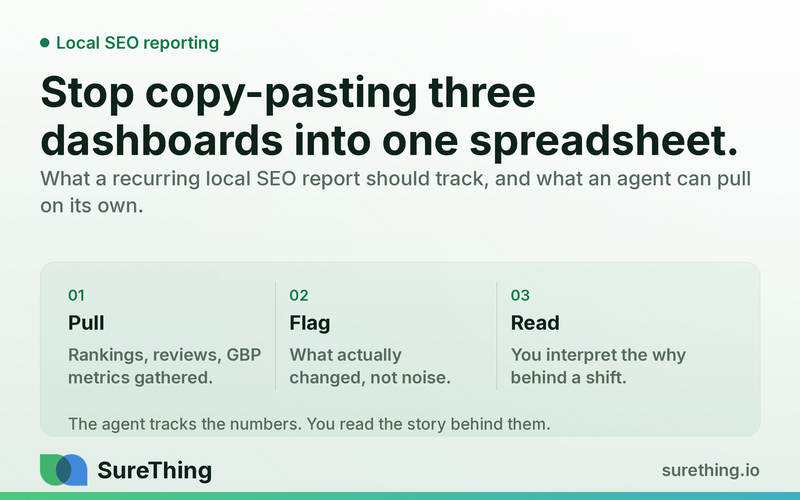
If you've been doing local SEO work for a few months — optimizing your Google Business Profile, building citations, collecting reviews, publishing local content — the question that actually matters isn't "did we do the work," it's "did the work do anything." A straight answer requires pulling data from Google Search Console, Google Business Profile insights, and whatever review platforms you're on, then looking at trend lines, not single-day snapshots. You can get that answer on a recurring basis without building a spreadsheet by hand every week, but it takes a defined report structure and something that pulls it consistently — not a one-off audit.
This is worth separating from the initial local SEO audit conversation. A local SEO audit checklist is a one-time diagnostic: is your NAP consistent, is your GBP fully filled out, do you have enough reviews. That's a starting-line exercise for a site that hasn't done the work yet. This article is about the finish line that never actually finishes — the ongoing measurement question for a business that's already running local SEO and needs to know, month after month, whether it's working or just... happening.
Key Takeaways
Local SEO reporting is a recurring measurement problem, not a one-time setup checklist — the question is "is it still working," asked on a schedule.
A useful report has four components: search visibility (impressions/clicks), keyword rank movement for a defined set, review count and rating trend, and GBP profile activity (views, calls, direction requests).
The real bottleneck isn't lack of data — it's that owners have three dashboards and no time to reconcile them into a comparable trend every week.
An agent can pull and assemble the numbers and flag what materially changed versus what's just noise; a human still needs to read the "why" behind a real move.
Ranking drops need a human eye — a Google algorithm update and a competitor's new content push both produce a falling line, but they call for very different responses.
Automate the pulling and assembling; keep a human in the loop for interpretation, competitive judgment, and anything that touches public-facing claims.
The real bottleneck: three dashboards, one story, no time to reconcile them
Most small business owners doing local SEO aren't short on data. Google Search Console gives you impressions and clicks by query and page. Google Business Profile insights gives you profile views, search-vs-maps discovery, and action counts like calls and direction requests. Review platforms — Google, Yelp, industry-specific sites — give you counts and star ratings. Each of these tools is fine on its own. The problem is that none of them talks to the others, and none of them tells you whether last month was better than the month before in a way you can act on.
So what actually happens: the owner or the person handling marketing checks GBP insights when they remember to, glances at Search Console every few weeks, and Googles their own business occasionally to see where they rank. There's no consistent baseline, no week-over-week or month-over-month comparison, and no flag when something actually changes. A ranking that drifted from position 4 to position 9 over six weeks doesn't look alarming in any single snapshot — it only looks alarming when you line up the snapshots. That lining-up is the work nobody has time for, and it's exactly the kind of work that gets skipped first when the week gets busy, which is most weeks.
The result is a business that's investing real time and money into local SEO — writing local pages, responding to reviews, keeping citations clean — with no reliable signal on whether any of it is paying off. That's not a tooling problem so much as an assembly problem: the data exists, it's just scattered and unreconciled.
A runnable workflow for standing local SEO reporting
Here's what a recurring local SEO reporting workflow looks like when an agent handles the pulling and assembling, and a human handles the judgment calls. This is the kind of ongoing monitoring that tools like SureThing's SEO monitoring agent are built to run in the background rather than as a one-time project.
Trigger
The workflow runs on a schedule rather than waiting for someone to remember it — typically weekly for the raw pull and monthly for the summary report an owner actually reads. A secondary trigger can be event-based: a sudden change in GBP call volume, a batch of new reviews, or a ranking swing outside the normal range for a tracked keyword can kick off an out-of-cycle check rather than waiting for the next scheduled report.
Read
On each run, the agent reads:
Google Search Console data for the site's local pages — impressions, clicks, average position, and click-through rate for the defined keyword set (not every keyword the site happens to rank for, just the ones that matter for the business).
Google Business Profile insights — profile views, search versus maps discovery split, and action counts: phone calls, direction requests, website clicks.
Review platforms — new review count, current average rating, and rating trend, plus flags for any review that needs a response.
Rank tracking for a fixed keyword set tied to the business's actual service area and services, so the comparison is apples-to-apples week over week rather than a moving target.
Does
The agent assembles the pulled numbers into a single trend view instead of a pile of raw exports, and drafts a short written summary that states what moved and by how much, compared to the prior period and, ideally, the same period last year if seasonality matters for the business. Crucially, the agent's job here is to flag what's materially different — a keyword that dropped three or more positions, a review rating that moved by a meaningful fraction of a star, a call volume that's meaningfully below trend — rather than repeating the same numbers with a new date stamp. It can also draft responses to new reviews for approval, note any citation inconsistencies it noticed while checking listings, and draft a short internal note on anything that looks like it needs attention before the next full report.
Nod
A human reviews the drafted summary before it goes out or gets acted on — approving review responses, confirming that a flagged ranking move is worth investigating, and signing off on any recommended next step like updating a page or requesting more reviews from recent customers. This is also where a business owner decides whether a flagged change is worth a deeper look, because the agent can tell you something moved; it can't always tell you why it matters to your business specifically.
Routine
Over time this becomes a standing habit rather than a project: a weekly pull that takes no manual effort, and a monthly summary that lands in an inbox or dashboard on the same day every month, structured the same way every time so comparisons are easy. The consistency is the point — a report that shows up reliably on the 1st of every month, formatted the same way, is far more useful for spotting real trends than an ad hoc check whenever someone thinks to do it.
General research on small business digital habits supports the idea that consistency and review activity both matter to how customers find and choose local businesses, which is part of why ongoing local search behavior data is worth paying attention to rather than treating local SEO as a set-and-forget project.
Manual spreadsheet reporting vs. automated pulling and assembly
Task | Manual spreadsheet approach | Agent-assembled approach |
|---|---|---|
Pulling GSC, GBP, and review data | Someone logs into three tools, exports or copies numbers by hand, usually weekly at best | Data is pulled on a fixed schedule automatically, with no manual export step |
Spotting what actually changed | Requires manually comparing this week's numbers to last week's, easy to miss smaller but real shifts | Agent compares against prior periods and flags moves that exceed normal variance |
Consistency of format over time | Depends on whoever's doing it that week; format and detail level often drifts | Same structure every time, so month-over-month comparison is straightforward |
Review response speed | Often batched whenever someone has time, sometimes days or weeks late | Draft responses prepared quickly for human approval, reducing lag |
Interpreting why a number moved | Falls entirely on whoever's compiling the report, if they have the context | Agent surfaces the change; a human still supplies the reasoning and context |
Where automation ends and judgment has to start
Being clear about the split between what an agent can run unattended and what needs a person is what makes this kind of reporting trustworthy rather than something you have to double-check anyway.
Can run unattended
Scheduled pulls from Search Console, GBP insights, and review platforms
Assembling trend views and flagging numbers that fall outside a normal range
Drafting the monthly summary write-up for review
Monitoring for new reviews and flagging ones that need a response
Checking listing consistency across directories in the background
Needs a human nod
Approving and sending drafted review responses, especially anything critical or unusual
Deciding whether a flagged ranking or traffic drop is worth a deeper investigation
Signing off on any content or page change recommended in response to the report
Deciding what gets escalated to a client versus handled internally, for anyone reporting on behalf of a client
Should never be automated
Public statements about why rankings or reviews changed, made without checking the actual cause
Any claims about business performance, revenue impact, or guarantees tied to SEO work — those should be handled carefully and, where they touch financial claims, kept conservative and factual
Responses to reviews involving legal threats, safety complaints, or anything with liability implications — those need direct human handling, not a drafted reply sent automatically
Decisions to change pricing, service offerings, or business strategy based solely on a report flag without deeper review
That last group is really the whole point of keeping a human in the loop. A report can tell you a keyword dropped from position 3 to position 8 over three weeks. It cannot tell you, on its own, whether that's because Google rolled out a core update that affected local results broadly, or because a competitor two blocks away just published a much stronger set of service pages and picked up a handful of new reviews. Those two situations look identical in a rank tracker and require completely different responses — one might mean "wait and monitor," the other might mean "we need better content and more reviews, now." Distinguishing between them takes someone who knows the local market, checks what changed in the search results themselves, and isn't just staring at a line graph. General guidance on interpreting search ranking volatility and algorithm changes backs up the idea that context matters more than the raw movement itself.
Frequently asked questions
How often should a local SEO report actually run?
Weekly for the underlying data pull, monthly for the summary a business owner reads. Weekly data lets you catch a real shift early; monthly summaries are the right cadence for judging whether a trend is real versus noise, without checking so often that you're chasing normal week-to-week variance.
What's the minimum a local SEO report needs to include?
At minimum: search impressions and clicks trend for local pages, ranking movement for a fixed set of keywords tied to the business's actual services and area, review count and rating trend, and GBP profile views, calls, and direction requests. Anything less leaves out either the discovery side (search) or the conversion side (calls, directions, reviews) of local SEO.
Can an agent tell me why a ranking dropped?
It can tell you that it dropped, by how much, and when the change started — which narrows down what to check. It can't reliably tell you the cause on its own, because that often requires checking what a competitor published, whether a broader algorithm update happened, or whether something changed on your own site around the same time. That's the part that still needs a person looking at the actual search results.
Is this different from a one-time SEO audit?
Yes, and it's worth keeping the two separate in your head. An audit is a diagnostic snapshot for a site that hasn't been optimized yet — checking NAP consistency, GBP completeness, review volume. Reporting is ongoing measurement for a site that's already doing the work, asked repeatedly over time. If you haven't done the initial setup work yet, that's a different starting point than what's covered here, and something a tool like SureThing's website audit agent is built to handle first.
Do I need separate tools for GSC, GBP, and reviews, or can one system pull all of it?
You can keep using the native tools — Search Console, GBP insights, your review platforms — as the source of truth, while having an agent pull from all three on a schedule and assemble them into one comparable view. That avoids replacing tools you already trust while removing the manual reconciliation step.
Getting a straight answer, on a schedule
The point of local SEO reporting isn't a prettier dashboard — it's being able to answer "is this working" without spending an afternoon reconciling three exports into a spreadsheet, and without waiting until something breaks to notice. Once the pulling and assembling is automated, the time that's left goes to the part that actually needs a person: reading the story behind a number, deciding what's worth reacting to, and making the call on what happens next.
If you're weighing what else could reasonably run on autopilot alongside local SEO reporting — listing checks, review monitoring, basic content drafts — it's worth seeing the fuller picture of what's realistic for a small operation right now, covered in this rundown of AI agents for small businesses in 2026. And if a recurring, no-spreadsheet local SEO report sounds like something worth having land in your inbox on the same day every month, it's easy enough to see what a setup like this costs on SureThing's pricing page before committing to anything.