September 7, 2026
How to Let AI Manage a Full Month of Social Media Scheduling
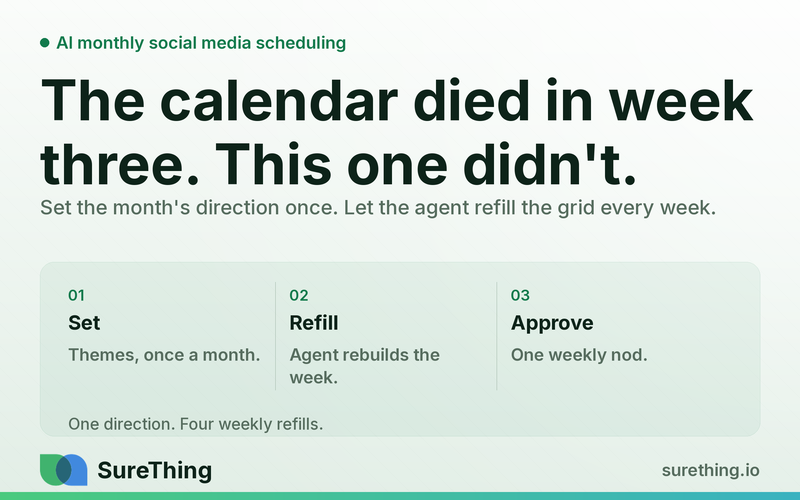
A monthly content calendar built once dies by week three because reality drifts and nobody rebuilds it. The mechanism that survives: a monthly direction set once, refilled weekly against real performance, with approval at the week level.
Key Takeaways
Managing a month of social scheduling by hand fails less often on the posting and more on the maintenance — the plan drifts within two weeks and nobody rebuilds it, so the account reverts to posting when someone remembers.
The fix that actually holds is not a bigger content calendar; it is lowering how often a human has to touch it — from approving every post to approving one week at a time, with the agent refilling the grid based on what worked the week before.
The real test of a month-scale system is what happens when the plan breaks: a holiday shifts everything, a launch needs to jump the queue, or a content type stops performing. A system that only works when nothing changes is not a system.
This is deliberately industry-neutral and distinct from a single-industry posting workflow — the mechanism generalizes across salons, gyms, clinics, or any small business running its own feed.
Nothing here claims specific engagement or growth numbers as guaranteed outcomes; the agent works from the business's own recent performance data, not invented benchmarks.
The Short Answer
A month of social scheduling does not fail because nobody built a calendar — most businesses build one at least once. It fails because the calendar built in week one assumes conditions that no longer hold by week three, and rebuilding it takes more effort than anyone budgeted for, so it quietly stops being followed. The mechanism that survives a full month is one where a human sets direction once — the themes, the cadence, the non-negotiables — and an agent refills the actual weekly grid based on what the business is doing and what recently performed, with approval sitting at the week level rather than the post level. This article covers that mechanism and, specifically, what has to happen when the plan gets interrupted, since that is where most manual calendars actually die.
Why the Calendar Dies in Week Three
A content calendar built for a month typically starts strong: a spreadsheet or planning tool with thirty cells, each one a planned post. An editorial calendar is used by publishers and businesses to control publication of content across different media and to ensure regular appearance of content that interests readers — the concept is old and sound. What breaks it in practice is that the calendar is built once, against assumptions about the month that stop being true almost immediately: a product sells out, a slow week gets busy, a piece of content that was supposed to be easy to shoot turns out not to be. Each of those is a small deviation. By week three there have been enough of them that the calendar no longer matches reality, and rebuilding a month's worth of planned posts is exactly the kind of task that gets postponed indefinitely.
The result is not usually "we stopped posting." It is "we post the easy stuff and skip the planned stuff," which slowly turns a planned calendar back into the same reactive habit it was meant to replace. The lesson is not that calendars don't work — it is that a calendar that requires a full manual rebuild every time reality shifts will get rebuilt approximately zero times after the first.
The Mechanism: Weekly Refill, Not Monthly Fixed Plan
The version that holds up treats the month as a standing direction, not a fixed grid. Once, at the start of the month, a person sets the themes, the services or topics in rotation, and anything that must appear on a specific date — a promotion, an event, a launch. That is the part that stays human and does not need to repeat weekly. Everything below that — which specific day gets which specific post, what the caption actually says, which theme gets more room this week because last week's version of it did well — gets refilled by the agent every week, using the direction set at the start of the month and whatever the business's own recent posts show about what is landing.
This is the same pattern documented in business process automation more broadly — AI-driven systems that interpret unstructured input and adapt to new situations with reduced reliance on constant human intervention, applied specifically to the one task (rebuilding the week's grid) that was killing the manual version of this workflow. The human sets the direction once; the system re-derives the specifics on a cadence a person can actually sustain reviewing.
The Runnable Loop
Trigger: the start of each week, on a fixed day
Not the start of the month — the start of each week. This is the cadence that matches how often reality actually shifts for a small business.
Read: the month's standing direction, last week's actual performance, and anything fixed on the calendar this week
The agent reads the themes and non-negotiables set at the start of the month, pulls whatever engagement or booking data exists from the past week's posts, and checks for any fixed date this week (a promotion, an event) that has to take priority.
Draft: this week's specific grid
The agent proposes what goes out on which day this week, weighted toward whatever theme performed better last week and away from whatever clearly did not, while still honoring the month's fixed direction and any date-specific commitment.
Nod: one approval, for the week
The person reviews the week's proposed grid — not each individual post — checks it against what they know is coming up that the system might not (a slow news week, a competitor's move, a mood the business wants to strike), and approves or adjusts.
Routine: the week posts, the next refill happens on schedule
Once approved, the week runs on schedule, and the next week's refill happens automatically at the same weekly trigger — no one has to remember to rebuild anything, because rebuilding is now a standing weekly event rather than a monthly project.
When the Plan Breaks — This Is the Actual Test
A system that only works when nothing unexpected happens is not a system worth building. Three interruptions are common enough to plan for explicitly:
A holiday or seasonal shift lands mid-month. The weekly refill reads the calendar date and adjusts that week's theme weighting automatically — this is exactly why refilling weekly instead of planning the whole month upfront matters; the interruption only has to be absorbed by one week's draft, not by unwinding thirty pre-planned posts.
A launch or promotion needs to jump the queue. This gets treated as a fixed calendar item for that week, the same as any other date-specific commitment set at the monthly-direction stage — it does not require throwing out the mechanism, just feeding it a new constraint for that week's draft.
A content type stops performing. The weekly read of last week's actual data is what catches this — the next week's draft shifts weight away from that theme without anyone having to notice the drop-off themselves and manually intervene.
What Runs Alone, What Waits for a Nod, What Never Automates
Task | Automation level | Why |
|---|---|---|
Reading last week's actual post performance | Unattended | Read-only; the input the weekly refill needs to adjust |
Drafting the coming week's specific grid | Unattended draft, one weekly approval | Repeats every week; low individual risk, needs a periodic sanity check |
Publishing the approved week's posts on schedule | Unattended after approval | Already-approved content, logistics only |
Adjusting weight for a holiday or known calendar event | Unattended, within the weekly draft | Rule-based against a known calendar, not a judgement call |
Setting the month's themes and non-negotiables | Human only | Direction-setting reflects the business's priorities, not data the agent has |
Deciding to launch an unplanned promotion mid-month | Human only | A business decision with cost and timing implications beyond the content itself |
Claiming specific growth or engagement numbers as guaranteed results | Never automated | No invented benchmarks; the agent reports the business's own actual data only |
How This Differs From a Single Post-and-Reply Workflow
A workflow built around one channel's posting and its inbound replies solves the day-to-day mechanics for that channel — what to post today, how to answer a DM, the same territory covered in a small business's day-to-day social media automation. This mechanism sits a level above that: it is the monthly direction and weekly refill discipline that keeps any of those channel-level workflows from drifting off course over four weeks. The two are meant to run together, not to replace each other — the monthly direction sets what a salon's or gym's weekly posting workflow should be drafting toward, and the weekly refill is what keeps that direction current as the month actually unfolds.
Businesses sometimes ask why this needs to be a separate mechanism rather than just checking in on the calendar occasionally. The honest answer is that "occasionally" is exactly the failure mode this replaces — a check-in that has no fixed cadence and no data behind it tends to happen when something has already gone visibly wrong, not before. A weekly refill with a scheduled trigger and a small amount of last week's real performance data behind it catches the same problems earlier, before they show up as a month that quietly went off-plan.
FAQ
What actually goes wrong if the weekly nod gets skipped for one week? Nothing catastrophic in a single week, but the point of the checkpoint is to catch a drift before it compounds — skip it twice in a row and the grid has now run two weeks on assumptions nobody actually checked, which is precisely the slow slide that killed the manual monthly calendar in the first place.
How much time does the monthly direction-setting step actually take? Roughly the time it takes to list this month's themes, any fixed dates, and anything explicitly off-limits — usually under an hour, and it only happens once a month rather than once a week.
What if the business doesn't have enough performance history yet to weight anything? The first few weeks default to the direction set manually, with no historical weighting applied — the refill mechanism starts contributing meaningfully once there are a few weeks of real data to read.
Does weekly approval mean less oversight than approving every post? It is less approval volume, not less oversight — a person is still reviewing everything before it goes out, just as a week rather than as thirty separate decisions, which is the trade that actually gets sustained past the first month.
Can this run without any human touch at all? No, and it should not — the weekly nod is the checkpoint that catches a wrong turn before four more weeks compound it. Removing it removes the main safeguard against the system drifting the same way a manual calendar drifts.
Does the weekly refill work the same way for a business that only posts once or twice a week rather than daily? Yes — the mechanism is about the cadence of rebuilding the plan, not the cadence of posting itself. A business posting twice a week still benefits from a weekly refill that checks last week's two posts against what actually landed, rather than running the same untested plan for a full month.
What's different about this from a generic AI scheduling tool? Most scheduling tools handle the posting mechanics — queueing content for specific times. This mechanism is specifically about who decides what goes in the queue each week and how that decision responds to what actually happened the week before.
Who actually owns the month's direction if there's more than one person involved in the business's marketing? Whoever currently makes that call manually should keep making it — the mechanism does not change who decides the themes and non-negotiables, it only changes how much manual rebuilding has to happen underneath that decision every week.
Getting Started
Set this month's direction once — themes, non-negotiables, any known dates — and let the first week's draft run against it with a manual approval. The real signal is week four: if the grid still reflects the direction set in week one without anyone having manually rebuilt it, the mechanism is doing its job.