June 25, 2026
AI Social Media Manager: Can AI Run Your Accounts?
A human social media manager costs $4-6k/mo. Here's what an AI social media manager can actually take over, where it still needs a human, and what to look for in 2026.
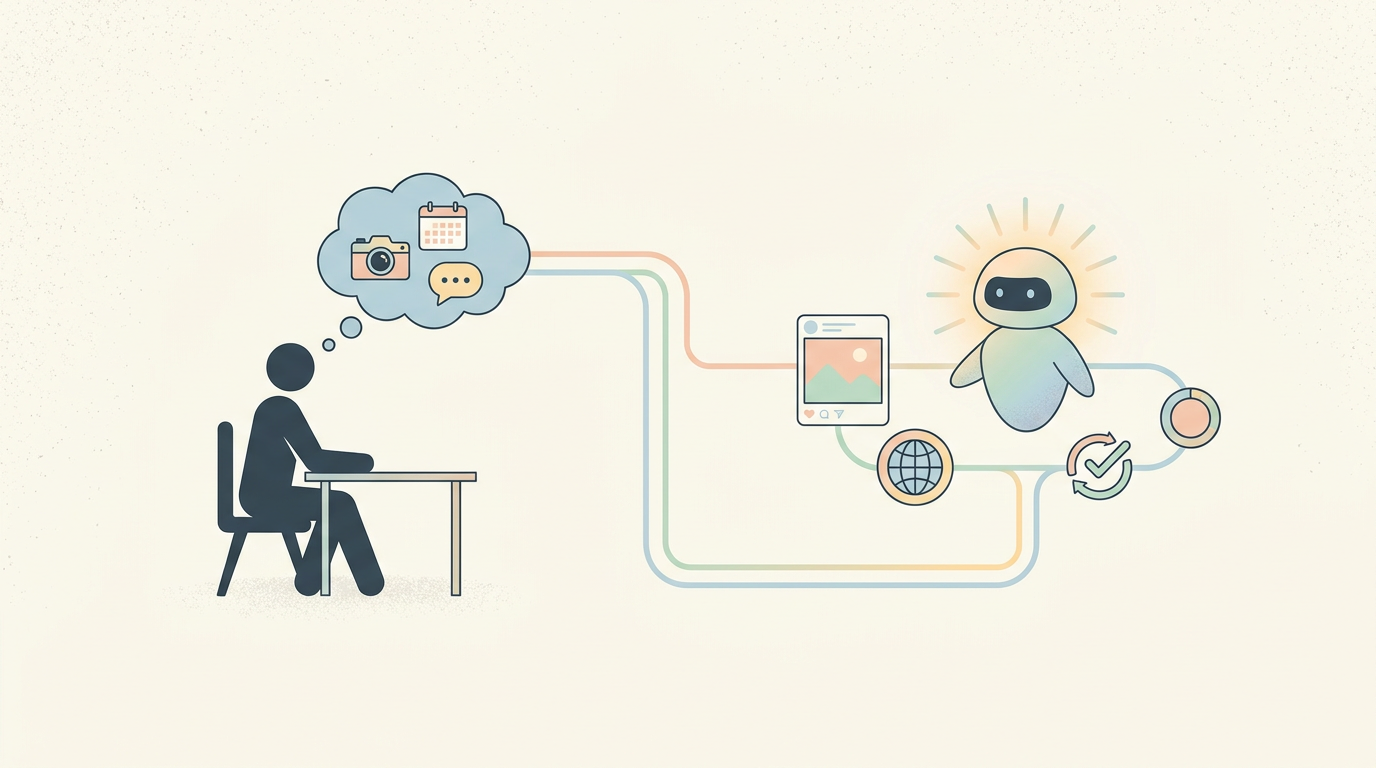
A good social media manager costs $4,000–$6,000 a month. Probably more if you want someone senior enough to actually own the channel strategy, not just move posts around a calendar.
So the question "can AI run your social media accounts?" isn't really a curiosity question anymore. It's a financial one. And the honest answer is: most of it, yes. Some of it, not yet. And the line between the two is more specific than most AI tool companies will tell you.
This guide covers what an AI social media manager can actually take over, where it still needs a human in the loop, what to look for when you're evaluating tools, and what a real AI ops setup looks like versus a fancy scheduler with a ChatGPT button.
What an AI social media manager actually does
The term gets used loosely, so let's define it precisely. A true AI social media manager doesn't just publish on a schedule. It handles the full production and monitoring loop that a human social media manager would own:
Content creation — pulling from your actual data sources (product updates, blog posts, announcements, GitHub commits, Notion docs) and turning them into platform-ready posts, not generic filler content
Per-platform adaptation — rewriting the same core message natively for each channel: LinkedIn gets the professional framing and longer format, Twitter gets the hook-first punch, Instagram gets the caption-and-hashtag block. Not copy-paste. Not copy-paste-plus-emoji.
Scheduling and publish timing — handling the calendar, managing posting cadence, and adjusting timing based on engagement patterns
Approval routing — surfacing each post for human review before it goes live, through a lightweight channel (email, Slack) so you stay in control without managing a content calendar manually
Inbox and comment monitoring — flagging replies, DMs, and brand mentions that need a human response, so nothing gets missed without someone scrolling the feed all day
Performance tracking — reading what worked and feeding that signal back into the next content cycle
That's the full loop. Most tools on the market cover one or two of those steps. A real AI social media manager covers all of them.
What AI can fully take over
These are the parts of social media management where AI handles the work reliably enough that a human doesn't need to touch them until the approval step:
Drafting and adapting posts — given the right data source and a consistent brand voice, AI produces platform-adapted content that's publishable with minor edits or none at all
Content calendar management — filling a posting schedule, maintaining cadence, and queueing content without someone manually assigning slots each week
Cross-platform formatting — thread structure for X, native document posts for LinkedIn, caption-plus-hashtag format for Instagram — each formatted correctly for its channel
Evergreen content recycling — surfacing older high-performing posts, adapting them for current context, and re-queuing them on rotation
Routine monitoring and triage — scanning mentions, DMs, and comment threads, categorizing them by urgency, and flagging anything that needs a human
Performance reporting — pulling engagement data, formatting it into readable summaries, and surfacing the signal worth acting on
Internal content sourcing — reading your connected data sources (blog, GitHub, product roadmap, Notion) and pulling content ideas and drafts without anyone having to brief the AI each time
The common thread here: these are high-volume, repeatable tasks where the pattern is learnable and the output is reviewable. AI handles the production; humans approve the output.
What AI still needs a human for
Here's the honest version most AI companies skip. There are real limits, and they matter:
Strategic pivots — if your messaging needs to change because of a market shift, a competitor move, or a product direction change, a human has to make that call. AI will keep executing the current strategy until someone updates the playbook.
Crisis communications — a PR issue, a negative viral moment, a sensitive industry event. The judgment about what to say, when to say it, and whether to say anything at all is not something AI should be autonomously posting through. This belongs in human hands.
Relationship-building — genuine engagement with community members, replies that require knowing someone's backstory, conversations that build real business relationships. AI can triage and flag; humans close.
Off-brand judgment calls — something is technically publishable but feels off. Maybe it's the timing. Maybe it's a joke that lands differently in context. That editorial instinct still lives with the human approver.
New channel strategy — deciding whether to launch on TikTok, restructure the LinkedIn presence, or go dark on a channel for a quarter. That's a human call, not a queue management problem.
High-stakes announcements — major product launches, leadership changes, partnership announcements. AI can draft; a human should own the final word.
This isn't a weakness in the technology. It's the correct architecture. An AI that auto-posts through a crisis isn't ambitious — it's a liability. The right system flags the exception and gets a human decision fast.
The human-in-the-loop reality: why approval routing matters
The smartest AI social media tools aren't the ones that post autonomously without human input. They're the ones that make the human approval step so lightweight that it doesn't create a bottleneck.
Here's what that looks like in a real workflow: your AI drafts three posts based on this week's product update — one for LinkedIn, one for X, one for Instagram. It surfaces all three to you in a Slack message. You read them in 90 seconds, click approve on two, and leave a quick note on the third. The approved posts go out; the third gets revised and re-surfaced. Total time: under two minutes.
Compare that to the alternative: your AI posts autonomously, one post goes out with an off-tone joke, and you're doing damage control at 11pm.
The approval loop isn't a compromise on automation. It's the feature that makes automation safe to run at full speed. The best AI social media management tools are built around this model — you're the decision-maker, the AI is the operator. Not the other way around.
What SureThing does differently
SureThing is built as a complete AI ops agent for social media — not a scheduler with AI bolt-ons. The architecture is designed around that production-and-approval loop described above:
Connects to your live data sources — blog, GitHub, Notion, product changelog — and pulls content without requiring manual briefs
Writes platform-native posts for each channel, adapted in tone and format — not the same sentence published everywhere
Routes every post through your approval channel (Slack, email) before anything goes live — you stay in control with minimal active management
Monitors replies and comments, flags items that need a human response, and keeps the inbox from becoming a black hole
Feeds performance signal back into the next content cycle — it gets better at your brand voice over time, not just your posting cadence
The pricing contrast is stark. A human social media manager: $4,000–$6,000 a month, full-time, for one person running one company's social presence. SureThing: paid plans from ~$30/month. The AI doesn't take vacations. It doesn't get overwhelmed. And it doesn't post anything that hasn't been approved.
That's not a scheduler with ChatGPT underneath. That's the manager's job, delegated to an AI that knows how to ask for permission.
See how it works: SureThing social media automation agent →
What to look for in AI social media management tools
Before you commit to any AI social media tools, run your evaluation against these criteria:
Does it generate content or just schedule it? Schedulers need you to create the posts. AI tools should be producing the drafts from your data. Know which one you're buying.
Is there an approval step? Any AI social media manager worth trusting should have a human-in-the-loop mechanism. Fully autonomous posting is a risk profile most businesses shouldn't run. Confirm the approval channel is fast enough that it doesn't become the reason you stop using the tool.
What are the content sources? The best AI social media management tools pull from your actual business — blog posts, product updates, data feeds. Generic "write me a post about X" prompting is closer to a chatbot than a manager.
Does it adapt per platform? One post published identically on LinkedIn, X, and Instagram is a sign the tool isn't doing the adaptation work. Platform-native formatting is a baseline requirement.
How does it handle monitoring? Publishing is half the job. Ask specifically how the tool handles incoming replies, comments, and DMs — whether there's a unified inbox, how it flags items for human response, and what falls through.
Does it learn your brand voice over time? A tool that gets better at sounding like you — based on what you approve, what you edit, what you reject — is compounding. A tool that produces the same generic output on day 90 as day 1 isn't replacing a manager; it's replacing a template.
What's the setup complexity? The best AI social media manager for small business is the one your team can configure and trust without a dedicated ops person maintaining it. If the onboarding requires a consultant, factor that in.
Can AI run your social media accounts?
For the repeatable 80% — yes. Content creation, scheduling, adaptation, monitoring, reporting — an AI ops agent handles all of it reliably, at a fraction of the cost of a human hire, running 24/7 without dropping the ball.
For the judgment-heavy 20% — crisis comms, strategic pivots, relationship moments, high-stakes announcements — a human stays in the loop. That's not a limitation. That's the correct design.
The question for most SMBs isn't can AI run social media — it's proven it can. The real question is: "am I still paying $5,000 a month for a human to handle the 80% an AI could do for $30?"
If the answer is yes, the math is simple. Start with SureThing →
For the broader context on what social media automation covers end-to-end, read the complete social media automation guide for SMBs.