May 12, 2026
You Don't Need an Agent. You Need a Solution.
Over the past six months, almost every AI product has started talking about Agents. But agents alone aren't enough for real work. You don't need an Agent. You need a Solution. Here's why — and what that distinction means for the next generation of AI work systems.
Over the past six months, almost every AI product has started talking about custom Agents. And for good reason: AI is no longer just answering questions — it's executing tasks.
But agents alone aren't enough for real work. You don't need an Agent. You need a Solution.
Here's why.
Real work requires context, external tools, task state, result presentation, user confirmation at key moments, and continuous learning over time. A single prompt, a timer, a browser action, or an automation flow doesn't cover that. The most valuable unit in the AI era isn't an Agent — it's a Solution that keeps the whole thing running.
Dimension 1: Pre-built vs. continuously evolving
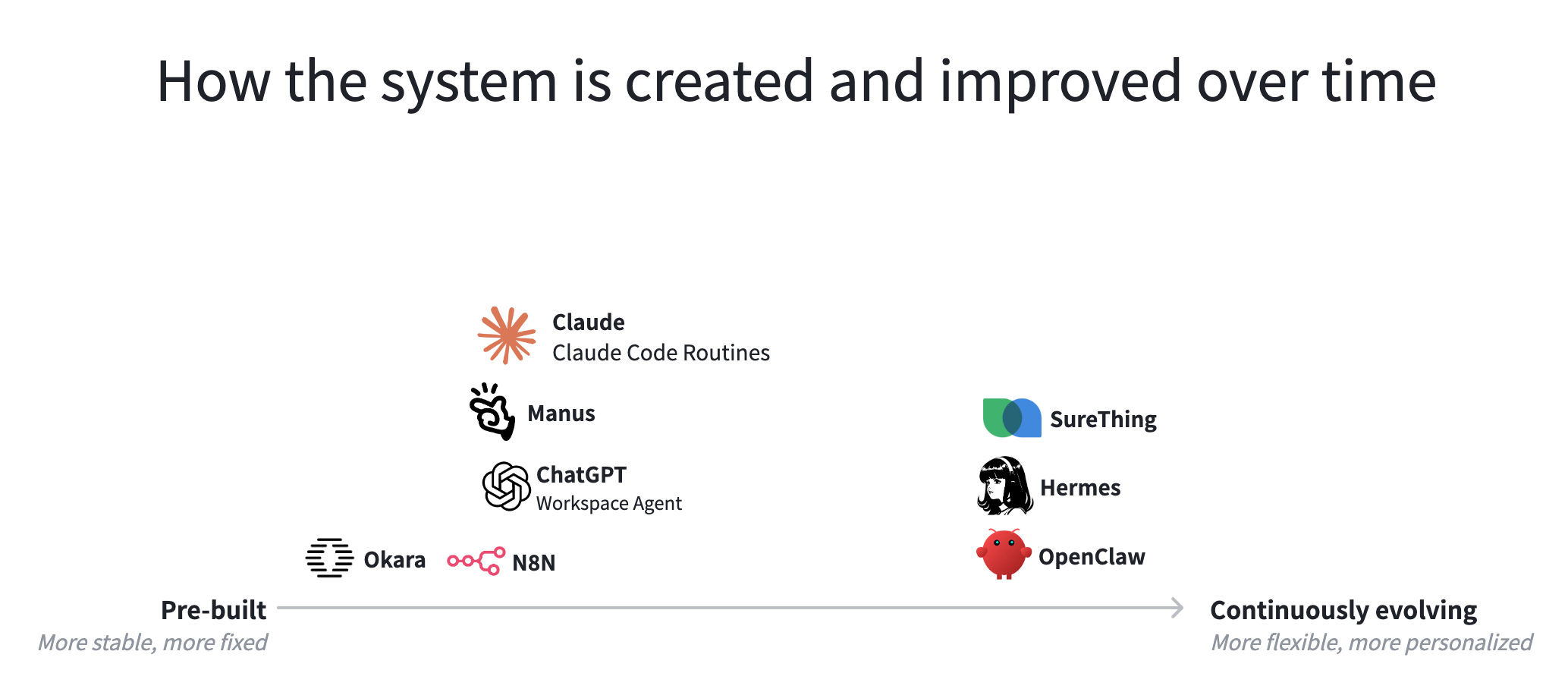
Today's AI work systems are moving in two directions.
The first is pre-built. Users create an Agent, Routine, or Workflow — configure the prompt, tools, trigger conditions, and execution mode — then the system runs from that setup. ChatGPT Workspace Agent, Claude Code Routines, n8n, Manus, and Okara sit more on this side.
The upside is stability. Pre-built systems are clear and controllable, easier to audit in enterprise environments. Okara goes further: more systematic and productized than most simple Agent tools. The problem is that Build and Use are still separated. When the task changes, the context shifts, or the user's preferences evolve, the system can't adjust on its own. The user has to go back into configuration mode.
The second direction is continuous evolution. OpenClaw and Hermes sit here. They don't split Builder from User the same way. The system can change while it runs — modify its own configuration, extend its capabilities, write new learnings back into its structure.
Real work doesn't stay the same. Customers change, projects change, goals change, information sources change. A system configured once shouldn't just execute mechanically forever. It should grow while it's being used.
Dimension 2: Single Agent vs. systematic Solution
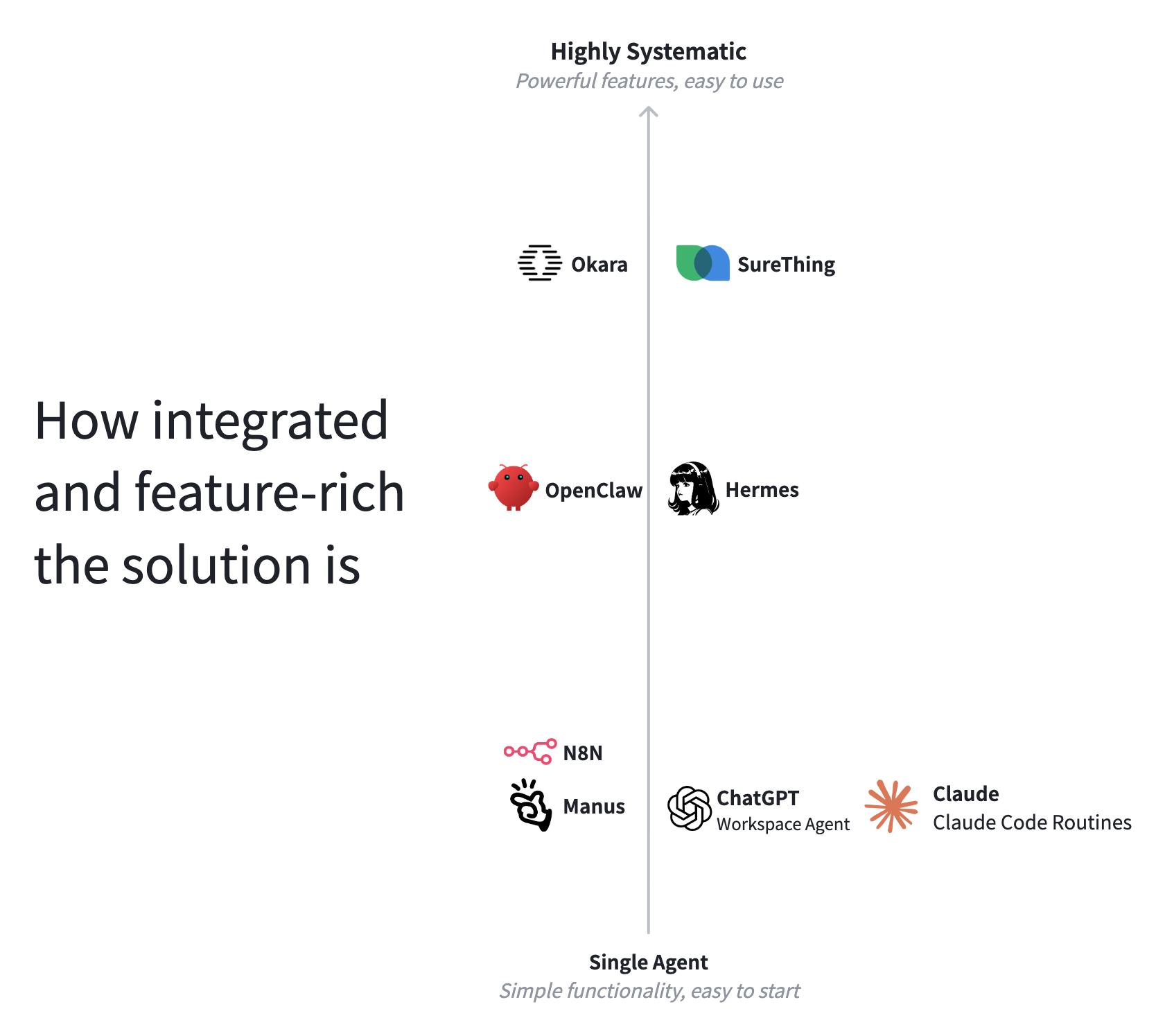
The second dimension is whether you're building an Agent or a Solution.
Most products still use the Agent, Routine, or Workflow as their core unit. ChatGPT Workspace Agent is a configured Agent. Claude Code Routines packages up advanced Claude Code usage patterns. n8n lets users build automation flows through nodes. Manus shows AI executing tasks inside a browser or computer.
These are all useful. But they're still closer to executors and workflows.
Real work usually needs a full system. A long-running task may involve multiple Agents, external connections, persistent context, task state, and a way to show results to the user. It shouldn't only return a text response, and it shouldn't only run silently in the background. Users need to see progress, status, pending confirmations, and next steps.
That's the difference between an Agent and a Solution.
An Agent answers: who executes?
A Solution answers: how does the work actually get done — over days, weeks, and entire project cycles?
SureThing's position
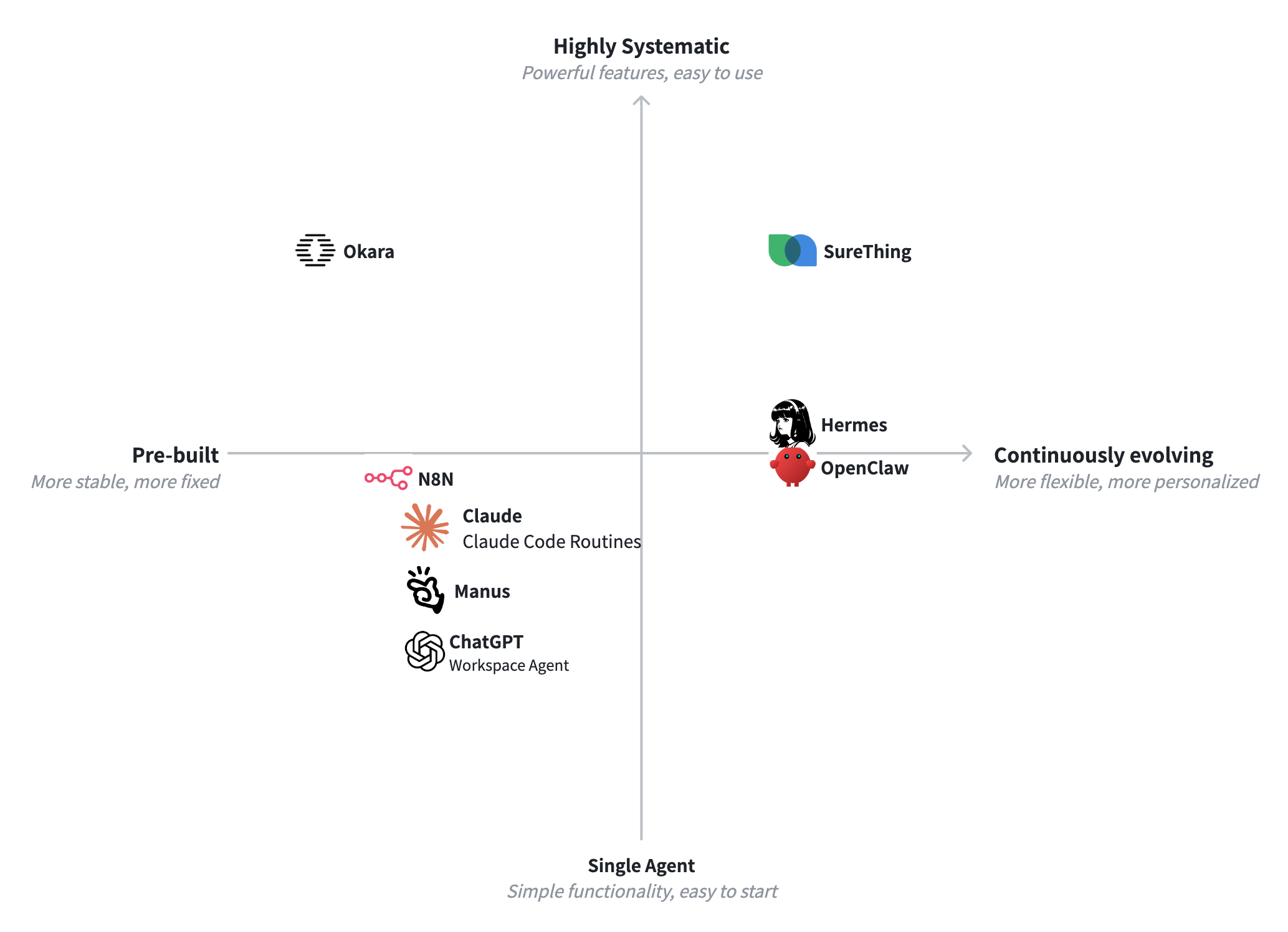
Put these two dimensions together and the market map becomes clear.
ChatGPT Workspace Agent, Claude Code Routines, Manus, and n8n cluster toward the lower-left to center-left. More pre-built, closer to single Agents, Routines, Workflows, or execution environments. Stable and clear, but limited in how much they can evolve — and not yet systematic enough.
Okara sits further up on the left. More systematic and productized, but still more pre-built than continuously evolving.
OpenClaw and Hermes sit further right. More flexible, more alive: systems can change at runtime, Agents can modify their own configuration, capabilities extend through file-based or runtime structures. The tradeoff is real. They feel more like frameworks or technical systems than products someone can pick up and use immediately.
SureThing aims for the upper-right. Continuous evolution over fixed pre-configuration. Solution over single Agent.
The goal is to keep the flexibility that OpenClaw and Hermes represent — and turn it into a product ordinary users can use out of the box.
Why Solution is the better unit
SureThing isn't another Agent Builder or another automation workflow tool. Users don't need an Agent. They need a Solution that keeps solving problems.
A SureThing Solution can include multiple Agents, Skills, Tasks, Connectors, Dashboards, file structures, and runtime state. What users see is a working interface: tasks, progress, suggestions, confirmation buttons, results, and next steps. Behind that is a set of Agent capabilities that keep running, learning, and adjusting.
Compared with ChatGPT Workspace Agent and Claude Code Routines: SureThing doesn't fully separate Build from Use. SureThing is Build by Use. Work keeps changing, so the Solution should adapt while it's in use.
Compared with n8n: users don't have to express their needs through nodes and flowcharts. Natural language, AI, and GUI work together. Users can describe their goals and confirm, modify, and give feedback directly.
Compared with Manus: SureThing isn't focused only on execution in a single session or inside a browser environment. A good demonstration creates an Aha Moment, but a useful work system has to run across days, weeks, and project cycles.
Compared with Okara: SureThing wants to keep the systematic feeling, but make the system less fixed. It should not only be powerful and easy to use — it should keep evolving as the user's work evolves.
Compared with OpenClaw and Hermes: SureThing keeps the ability to evolve continuously without exposing the underlying complexity. Users shouldn't need to install files, edit configuration, understand runtimes, or manage gateways. They should get a Solution that works.
Conclusion
The next generation of AI work systems shouldn't stop at Agents.
An Agent is an execution unit.
A Solution is what users actually need.
It understands goals, connects tools, presents status, manages tasks, executes continuously, and gets better at working with you over time.
You don't need an Agent. You need a Solution that actually gets things done.