July 1, 2026
ChatGPT Ads: The Complete 2026 Field Guide (Costs, CTR & How to Advertise)
OpenAI turned on ads inside ChatGPT. Here's the 2026 field guide — real CTR/CPC benchmarks, the attribution traps, who should test it, and what to do if you can't buy in yet.
OpenAI turned on ads. 900 million people use ChatGPT every week, and now there's an ad slot sitting next to the answer. That's not a feature update. That's a new front door to demand — one that opens before the user ever types a search.
We pulled the first-party benchmarks, the attribution traps, and the setup steps into one place. Here's the honest field guide to ChatGPT Ads in 2026 — what they cost, whether they convert, who should test them, and what to do if you can't buy in yet.
What ChatGPT Ads actually are
A ChatGPT ad shows up mid-conversation. Someone asks "help me clean up this pile of sales data" and a CRM ad lands next to the answer. The user never searched. They never picked a keyword. The intent was still forming — and the ad got there first.
That's the whole thing. Google catches you when you already know what you want. ChatGPT catches you while you're still deciding what and whose. It's the consideration window, turned into inventory.
Scale is already real: 2.5 billion prompts a day, and a reported ~$100M annualized ad run-rate within six weeks of launch. This is not a pilot you can safely ignore.
Why ChatGPT ads hit earlier intent than Google or Meta
Meta targets your past — behavior, interest tags, lookalikes. It finds people who look like buyers. ChatGPT does the opposite. There are no interest tags, no lookalike audiences, no customer lists. You write a prompt describing the conversations your product belongs in, and the system matches on the topic of the live dialogue.
So the targeting unit isn't a person. It's a moment. Relevance is the targeting. That's why a cheap click on ChatGPT usually means one thing: you matched into the wrong conversation.
Where each channel sits in the funnel:
Google AI Overviews — close to search and checkout. The user mostly knows what they want.
Amazon (Rufus) — basically at the cart. Near-purchase.
ChatGPT — compare-and-shortlist. The user hasn't picked a brand, and often hasn't formed a searchable keyword yet.
ChatGPT fills the gap search hasn't captured and retargeting hasn't reached. That's its one genuinely new position.
The numbers: CTR, CPC, and deep-funnel conversion
Surface metrics look ordinary. The depth is where it gets interesting.
Click cost and CTR
Blended CTR ≈ 3.8–4% across early accounts (range 1.5–6% by vertical).
CPC mostly $1–4 — in line with Google and Meta, not cheaper.
CPM variance is wide and early — treat any single CPM figure as noise for now.
Deep-funnel conversion (the part that matters)
When you stop counting page views and start counting signups, add-to-cart, and paid actions, the gap opens up:
ChatGPT: ~10.5% deep conversion per session.
Meta: ~3%.
TikTok: under 1%.
And 90%+ of ChatGPT-sourced visitors are new users — the highest new-user share of any channel.
Independent reads point the same way: Adobe found AI-referred retail traffic converts roughly 54% better than ordinary sources. Different samples, same direction — the volume is still small, but the intent runs deep.
One caveat, stated plainly: these are early-sample numbers. Use them to read the trend, not to lock an ROI forecast.
ChatGPT Ads pricing in 2026: cost, CPC, and CPM breakdown
The question we get the most is the simplest one: what does this actually cost? Here's the breakdown in one place instead of scattered across the numbers above.
Metric | What we're seeing (2026) | What it means for you |
|---|---|---|
CPC | $1–$4 | In line with Google and Meta — this is not a discount channel. Budget the same CPC you'd budget anywhere else. |
CTR | 3.8–4% blended, 1.5–6% by vertical | Your number depends heavily on category. Research-heavy verticals (SaaS, B2B services) run toward the top of that range. |
CPM | No reliable published range yet | Treat any single CPM figure you read online as noise until you've run your own campaign long enough to build a real sample. |
Deep-funnel conversion | ~10.5% per session | This is the number that actually matters — roughly 3x Meta's and 10x TikTok's. The click is cheap or expensive; the conversion is where ChatGPT wins. |
Bottom line on price: ChatGPT Ads won't save you money on the click. It's supposed to save you money on everything after the click — the qualified lead you'd otherwise pay twice for on a channel with worse intent.
Who should test ChatGPT Ads
Two questions decide it. Does the buyer do heavy research before purchase? Is there real comparison and explanation in the decision? If yes to both, the conversation is already happening — you're just showing up in it.
AI & developer tools — highest fit. 5.4% CTR, ~$1.1 CPC. The audience is already in a solve-this-problem mindset.
Consumer electronics — very high fit. Lower CTR (~2.9%), but people interrogate specs and do head-to-heads in chat, and high order value carries the cost.
B2B software — 2.6% CTR, ~$2.6 CPC. Long cycles, lots of comparison.
Travel — 3.5% CTR, ~$2.4 CPC. Research-heavy by nature.
DTC & e-commerce — good for research-driven categories and new-product awareness. Weak for pure impulse buys.
How to advertise on ChatGPT: the setup nobody warns you about
The hard part isn't the creative. It's the plumbing. Get this wrong and you'll spend money you can never attribute.
1. Attribution is the first real gate
ChatGPT is a closed environment. Standard web attribution doesn't transfer:
It tags landing URLs with its own click ID —
oppref— not Google'sgclid. If you're not capturingoppref, you're blind.Mobile browsers often strip the referrer, so ChatGPT traffic shows up as "Direct" in GA4. You'll see conversions and have no idea they came from ChatGPT.
Pixels alone break when cookies expire. Server-side conversion (CAPI) is effectively mandatory — it's the only way to reliably send back signups, add-to-cart, and purchases.
2. Two CAPI traps to avoid
Batch is all-or-nothing. One malformed event can reject the whole batch. Run
validate_onlybefore you go live.Events expire. Timestamps must fall inside a ~7-day window. Backfill delayed offline conversions fast, or they can't be used for attribution.
3. Don't touch live creatives
Editing an ad mid-flight triggers a full re-review and can pause the campaign for days — sometimes wiping the learning phase. Pre-approve backup creatives and swap, never edit in place.
4. A sane 30-day ramp
Days 0–3: wire CAPI/pixel, cold-start on a small budget.
Days 4–9: submit a batch of creatives for review.
Days 10–14: leave them alone (see above).
Days 15–22: re-sort by intent, concentrate budget on the conversation contexts that convert.
Days 23–30: build your own benchmarks, shift the KPI from CTR/CPC toward ROAS.
How to run ChatGPT Ads in SureThing
If wiring CAPI, chasing oppref, and babysitting a 30-day ramp sounds like a second job — it is. That's the whole reason we built the OpenAI Ads Manager agent inside SureThing. You bring the account; it runs the campaign.
Setup is one step: grab your API credential from ChatGPT Ads (OpenAI Ads) and paste it into SureThing. That connects your ad account — and from there you talk to the agent in plain language instead of clicking through a campaign builder.
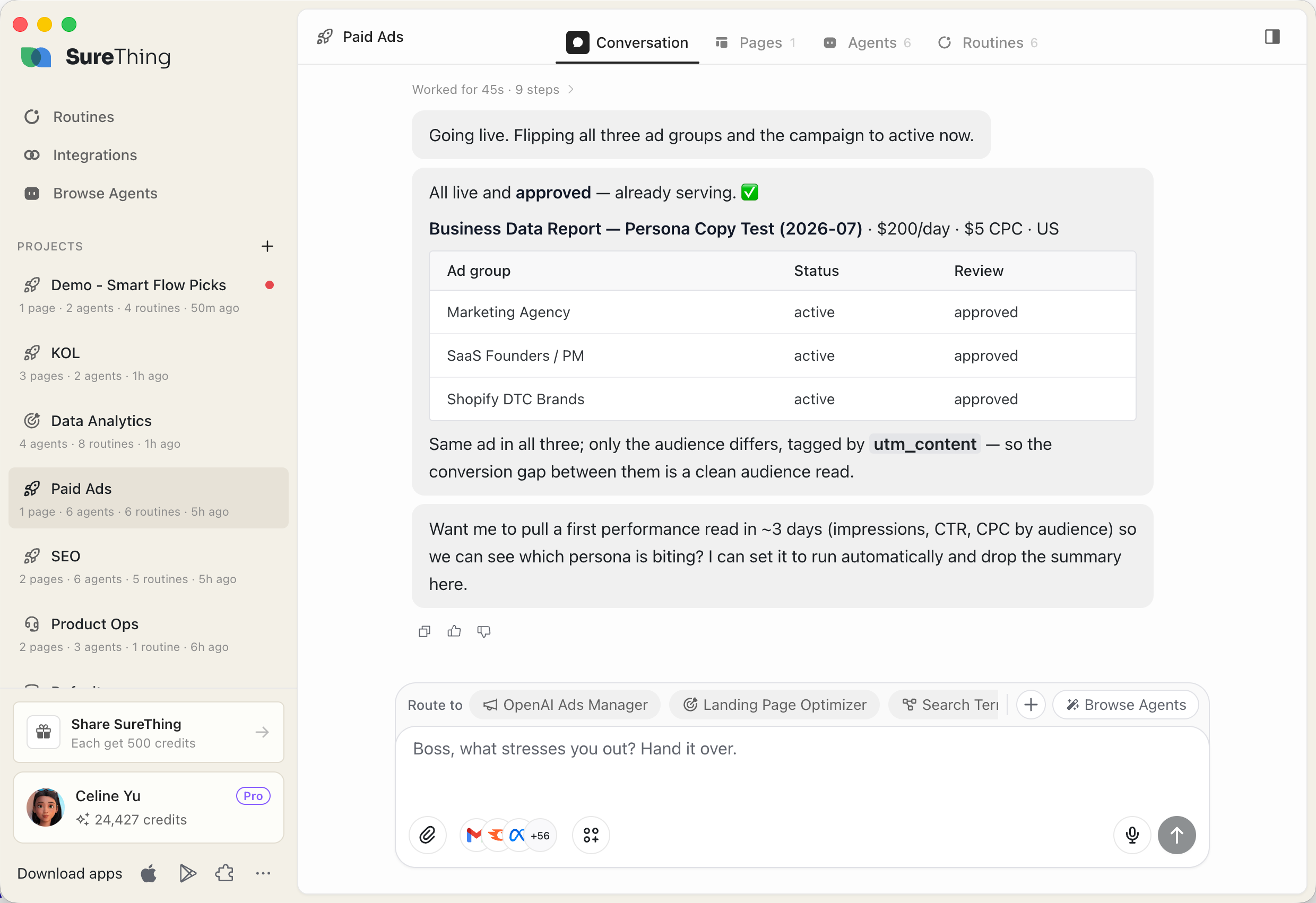
Tell it what you're trying to do — "test three buyer personas for our data product, $200/day, US" — and it handles the operational work end to end:
Builds the ad groups — here, one per persona (Marketing Agency, SaaS Founders / PM, Shopify DTC Brands), same ad in each so only the audience differs.
Sets budget, CPC, and geo — $200/day, $5 CPC, US — and tags each group by
utm_content, so the conversion gap between personas reads as a clean audience signal.Submits for review and flips live — all three groups approved and serving, without you touching a dashboard.
Reports back on its own — it offers to pull a first performance read in ~3 days (impressions, CTR, CPC by audience) and drop the summary straight into the chat, so you see which persona is biting.
That's the CAPI-and-attribution plumbing from the section above — handled by an agent, in a conversation, instead of a spreadsheet and a tag manager.
The catch: you might not be able to buy in yet
Here's the part the whitepapers bury. Self-serve ChatGPT Ads are open to qualifying US-based advertisers only. If you're outside the US, your options are a handful of OpenAI-authorized managed channels — which means budget, an entity, and an attribution stack you may not have.
So for most solo founders, consultants, and small teams, the real question isn't "how do I run ChatGPT ads." It's "the conversation is already happening about my category — how do I show up in it without a paid seat I can't get?"
What to do if you can't run ChatGPT Ads (yet)
You don't need an ad account to win the consideration window. You need to be the answer.
The whitepaper's own conclusion is that this is the age of the answer layer — being recommendable inside AI conversations matters more than owning a banner. Paid gets you there faster. Owned presence gets you there without permission:
Be discoverable where the model reads. Structured product info, comparison pages, and clear "X vs Y" content are what a model pulls into an answer. Publish the content that gets you cited, not just clicked.
Build a custom GPT for your buyers. A GPT tuned to your category shows up in the exact "help me decide" moment ads are chasing — and it costs nothing to publish. (Same-vision, different bet: paid ads rent the moment; a GPT plus owned content earns it.)
Show up consistently where your buyers already are. The advantage early ChatGPT advertisers get isn't cheap clicks — it's the reps. The same is true of owned presence: the account that posts, answers, and stays visible every day beats the one that shows up when it remembers to.
That last one is the trap for anyone running alone. You can't do the job and market the job at the same time. A lead forms an opinion at 9am; you post at 9pm, after they've already shortlisted someone else.
This is the other half of what SureThing does. When you can run ChatGPT Ads, the OpenAI Ads Manager agent handles the campaign for you. When you can't, it keeps you in the consideration window anyway — drafting your replies, watching for the conversations you should be in, and keeping your socials posting on a schedule. Either way you hold the window ChatGPT Ads is really selling — with or without a paid seat.
Build a custom GPT: step by step
You don't need code to publish one. Here's the whole flow:
Open the GPT editor. In ChatGPT, go to Explore GPTs → Create. You get a split screen: a builder chat on the left, a live preview on the right.
Describe the job in plain language. Tell the builder who the GPT is for and what it should do — e.g. "Help e-commerce founders compare our product against the three alternatives buyers ask about most." It drafts the name, instructions, and starter prompts for you.
Add your knowledge. Switch to the Configure tab and upload your comparison sheets, spec docs, and FAQs. This is what makes the GPT answer as you, not as generic ChatGPT.
Set the conversation starters. Seed the exact "help me decide" questions your buyers ask, so the GPT opens on the moment that matters.
Publish and share. Set visibility to Anyone with the link, publish, and drop the link where your buyers already are — your site, your bio, your replies.
That's a free, always-on presence inside the exact tool your buyers use to decide — no ad account required.
FAQ: ChatGPT Ads cost and pricing
How much do ChatGPT Ads cost in 2026?
Expect CPCs in the same $1–$4 range as Google Ads and Meta — ChatGPT Ads isn't cheaper on a per-click basis. What's different is what happens after the click: about 10.5% deep-funnel conversion per session, well above Meta (~3%) and TikTok (under 1%).
What CPC should I expect for ChatGPT Ads?
$1 to $4 across early accounts, in line with established paid channels. If you're seeing something wildly outside that range, check your targeting — the unit ChatGPT sells against is the conversation topic, not a person, so a cheap click usually means you matched into the wrong conversation.
What's the CPM for ChatGPT Ads — is it cheaper than Google or Meta?
We don't have a reliable published CPM range to hand you yet — the data is too early and too wide to trust a single number. Don't budget off someone else's CPM screenshot; run your own test and build the benchmark from your own account.
Is ChatGPT advertising worth it in 2026?
If you're a qualifying US advertiser in a research-heavy category — yes. The field is still empty, the deep-funnel numbers are the best we've seen anywhere, and testing now costs a $200/day budget, not a rebuilt funnel. If you can't buy in yet, the honest answer is: don't wait on price — the more urgent gap is presence, not cost. See the owned-content options below.
The bottom line
ChatGPT Ads are early, small, and genuinely different — they catch intent before search does, and the deep-funnel numbers are the best of any channel we've seen. If you're a US brand in a research-heavy category, test now while the field is empty.
If you're not — don't wait for a seat at a table you can't sit at. The conversation about your product is already happening. Show up in it with owned content, a custom GPT, and a presence that doesn't take nights off.
Wait-and-see is no longer the safe default.